How to Calculate a Development’s VGV and Document Every Assumption
VGV, or Valor Geral de Vendas, is the aggregate list value of the commercial inventory included in a defined scope on a declared date. It supports product and…
Imovitec · September 22, 2026
VGV, or Valor Geral de Vendas, is the aggregate list value of the commercial inventory included in a defined scope on a declared date. It supports product and economic validation only when inventory, prices, inclusions, exclusions, and calculation rules are reproducible.
The sources reviewed do not establish a universal statutory VGV formula. The method below is an operational convention, not a legal definition. Brazil’s Law 4,591/1964 governs building condominiums and real estate developments, but its consolidated text and each project’s legal documents still require specialist review.
Key takeaways
An auditable VGV begins with reconciled inventory and one approved price-list version. It preserves the base date, scope, units, assumptions, and unresolved data. The result is a commercial indicator, not automatic evidence of accounting revenue, cash receipts, margin, profit, or the present value of future receipts.
- Calculate gross VGV by adding quantity multiplied by unit list price for every included commercial item.
- Use one declared base date and one approved, version-controlled price list.
- Use a quantity-weighted average when multiplying total units by an average price.
- Separate apartments, parking spaces, storage units, shops, and other independently priced rights.
- Define every deduction before using the term “net VGV.”
- Keep missing quantities or prices pending and block publication of a definitive total.
For the indicator’s strategic role, see what VGV is and how it can inform a launch strategy.
What is the most auditable way to calculate gross VGV?
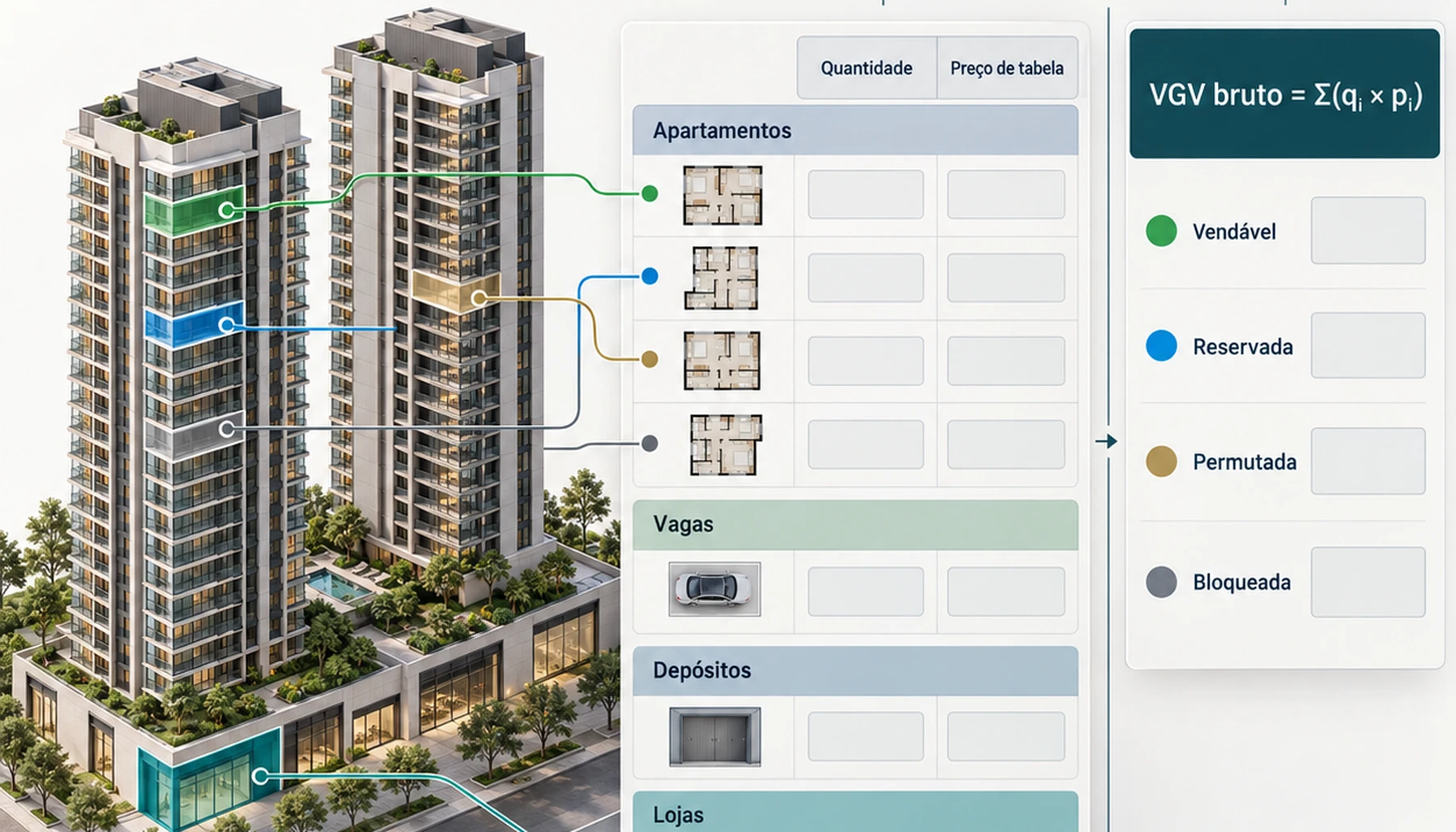
The most auditable operational method adds the list value of every commercial item in the approved scope. In compact form, gross VGV equals the sum of each included quantity multiplied by its unit list price. All quantities and prices must refer to the same declared base date.
Gross VGV = Σ(qᵢ × pᵢ), expressed in nominal Brazilian reais at the declared base date unless the study states another convention.
This formula is an operational inference from inventory aggregation. It was not identified as a universal formula in Brazil’s Law 4,591/1964, published on 16 December 1964, or in another retrieved normative source.
| Commercial item | Quantity | Unit list price | Included value | Data status |
|---|---|---|---|---|
| Apartment type A | q₁ | p₁ | q₁ × p₁ | Confirmed or pending |
| Apartment type B | q₂ | p₂ | q₂ × p₂ | Confirmed or pending |
| Parking spaces | q₃ | p₃ | q₃ × p₃ | Legal and commercial review |
| Storage units | q₄ | p₄ | q₄ × p₄ | Legal and commercial review |
| Shops | q₅ | p₅ | q₅ × p₅ | Confirm phase and scope |
Units may share a row only when they share the relevant price. Differences in floor, view, orientation, parking allocation, or another priced attribute require separate rows or unit-level calculations.
Use full precision for every component. Add unrounded values, then round the final total to cents or the stated reporting unit. Never silently estimate a missing quantity or price. Mark the row as pending and withhold the definitive total.
Can total units be multiplied by an average price?
Yes, provided the average is weighted by unit quantities or every included unit has the same price. A simple average of type-level prices can distort VGV when the types contain different numbers of units. Any complete average also requires a confirmed price for every included type.
Weighted average price = Σ(qᵢ × pᵢ) ÷ Σqᵢ. Gross VGV then equals total included units multiplied by that weighted average.
The denominator is the total number of included units. State the displayed decimal places, but retain full internal precision until the final total is rounded.
External comparisons need another safeguard. A competitor’s advertised or list price is not direct evidence of its completed transaction price. See how to read a competitor’s sales table.
Which items belong inside the VGV perimeter?
The VGV perimeter is the documented set of phases, units, and commercial rights included in the calculation. Apartments are only one category. Parking spaces, storage units, shops, and other rights belong on separate lines when independently marketed or assigned their own prices.
This treatment is an operational inference, not a universal legal rule. It depends on the development memorial, registrations, contracts, and approved commercial structure. The nature of parking spaces, exchanges, and other rights requires legal review.
Reconcile at least these inventory categories:
- Available units
- Reserved units
- Units committed to physical or financial exchanges
- Blocked units
- Sold units and remaining inventory for post-launch analyses
- Items with unresolved status
State whether each category is included. The treatment must suit the study’s purpose and remain consistent across comparisons.
Phases require the same discipline. A phase-one VGV cannot contain later-phase inventory. A whole-development calculation needs compatible dates and pricing assumptions, with uncertainty disclosed when future price lists remain unapproved.
Which assumptions must the calculation declare?
A reproducible VGV gives another qualified reviewer enough information to rebuild the total without guessing. Its calculation record should identify the commercial perimeter, source documents, owners, timing, treatment of every inventory category, calculation bases, rounding policy, unresolved inputs, and any specialist review still required.
Record at least:
- Included development perimeter and phases.
- Base date and price-list version.
- Currency and nominal or real-value convention.
- Inventory by type and commercial item.
- Treatment of available, reserved, exchanged, blocked, sold, and remaining units.
- Treatment of parking, storage, shops, and separately priced rights.
- Exact area concept when area-based pricing applies.
- Full list price and treatment of discounts.
- Contractual adjustment index and frequency, when applicable.
- Sales and receipt schedules beyond a base-date snapshot.
- Cancellation, default, and remarketing assumptions.
- Commissions, taxes, and their calculation bases.
- Physical and financial exchanges.
- Rounding, missing-data, and scenario rules.
- Source and responsible owner for every input.
Mixing inventory from one date with prices from another creates a total that does not represent a genuine commercial position. Connect the calculation to the review of price per square metre, unit type, inventory, and VSO, while keeping VGV distinct from sales velocity.

When can VGV be calculated from area?
Area-based VGV is appropriate only when the commercial policy prices each item through a clearly identified area and a corresponding list price per square metre. The calculation must preserve the declared area concept, price precision, base date, and any missing-data restrictions before producing a total.
VGV by area = Σ(Aⱼ × Pⱼ), where Aⱼ is the declared area and Pⱼ is the applicable list price per square metre.
Name the denominator behind the price, such as the commercial private area considered. Private, common, equivalent, and constructed areas cannot be exchanged or converted without a documented rule.
ABNT NBR 12721:2006 belongs to the technical context of unit-cost evaluation and incorporation documentation. Its licensed full text was not recovered for this article. Detailed definitions, tables, current validity, and amendments must therefore be checked in the licensed edition. Cost-analysis area is not automatically saleable area.
Talk to a specialist
Want to see this applied to your case?
Instead of finishing the article and staying in theory, send us your situation on WhatsApp. We reply with the concrete next step.
Can FipeZAP or market indicators determine a project’s VGV?
No. The FipeZAP Index can provide external context about advertised sale and rental prices within its coverage, but it neither replaces the project’s approved price list nor directly represents completed transaction prices. The operational VGV still comes from reconciled project inventory and approved internal prices.
The Fundação Instituto de Pesquisas Econômicas FipeZAP page, observed on 14 September 2026, describes an index based on property advertisements. A numerical citation would also require its competence period, geography, filters, weighting, and duplicate treatment.
The ABRAINC/Fipe Indicators page, observed in 2026, covers launches, sales, deliveries, final supply, and default in its participating market. The retrieved page did not provide enough methodology to reproduce sample composition, representativeness, detailed definitions, or revisions.
These indicators can inform judgment, but cannot produce the project’s VGV. That distinction also matters in a real estate feasibility study before buying land.
ABNT NBR 12721:2006 belongs to the technical context of unit-cost evaluation and incorporation documentation.
Is VGV the same as revenue, cash, margin, or profit?
No. Gross VGV is an aggregate list-value indicator at a declared date. Accounting revenue depends on applicable standards, contracts, and accounting policies. Cash depends on actual receipt schedules. Margin and profit require costs, taxes, and other recognized economic or accounting effects.
The Brazilian Comitê de Pronunciamentos Contábeis discussed real estate development revenue in connection with CPC 47 and OCPC 04. The recovered OCPC 04 consultation page is not confirmation of every final requirement currently in force. CPC 47, ICPC 02, OCPC 04, their approval status, and contractual application require accounting review.
Present value is also different from nominal VGV. It equals the sum of each period’s cash flow divided by the applicable discount factor. The calculation requires a complete receipt schedule and rates consistent with currency, inflation, risk, and periodicity. Missing cash flows or rates remain pending.
What does “net VGV” mean?
“Net VGV” means only what the study expressly defines. No universal normative definition was identified in the retrieved sources. A reproducible result therefore starts with gross VGV and shows every deduction, sign, amount or approved assumption, calculation base, period, and unresolved input.
A documented convention may deduct discounts, commissions, specified sales taxes, exchange effects, and expected cancellation or default losses. Each deduction must identify whether it applies to list price, contracted price, receipts, or another base.
Do not invent missing percentages. Present clearly labelled scenarios or block the net result until responsible owners approve the inputs. Final review should reconcile inventory to legal and commercial records, prices to one approved table, and every adjustment to its source.

Sources and limitations
The sources below support the stated scope and qualifications. They do not establish a universal statutory VGV formula, standard deduction percentages, or automatic equivalence between VGV and accounting or financial measures. Legal, accounting, tax, and financial conclusions require review against current official texts and project documents.
- Presidency of the Republic, Law 4,591 of 16 December 1964, accessed 22 September 2026. The retrieved record confirmed title and scope, but not all consolidated articles or amendments.
- ABNT NBR 12721:2006. The official catalogue page and licensed text were not recovered. Confirm the current edition, amendments, definitions, and tables through the Brazilian Association of Technical Standards.
- Brazilian Chamber of the Construction Industry, discussion about updating NBR 12721:2006. Institutional context only.
- Comitê de Pronunciamentos Contábeis, consultation on revised OCPC 04. Consultation material, not confirmation of all final requirements.
- Fipe and ABRAINC, ABRAINC/Fipe Indicators, page observed in 2026. Detailed methodology was not recovered.
- Fipe, FipeZAP Index, page observed on 14 September 2026. Based on advertisements rather than final transaction prices.
FAQ
How do I calculate a real estate development’s VGV?
Calculate gross VGV by summing the approved list price of every marketable unit and separately priced item within the declared scope: VGV = Σ(quantity × unit price). Use one price-list version and base date. Do not estimate missing prices; identify them as pending and withhold the definitive total.
What does VGV mean for a real estate development?
VGV is the aggregate list value of the commercial inventory included in a defined development scope on a stated date. It is a commercial indicator used in economic validation. VGV does not automatically represent recognized revenue, cash receipts, margin, profit, or the development’s market value.
How do I tell the difference between assessed property value and VGV?
Assessed property value and VGV measure different things. An assessed value follows the applicable governmental basis for a property, while VGV aggregates the development’s declared commercial inventory at list prices. Never substitute one for the other without documenting the purpose, valuation date, scope, and governing criteria.
Can VGV be calculated from saleable area and price per square metre?
Area-based VGV is valid only when the commercial policy prices each item using a clearly defined area and corresponding price per square metre. State whether the denominator is private saleable area or another measure. Do not silently convert private, common, equivalent, or constructed areas, including figures prepared under NBR 12721.
What assumptions should be documented in a VGV calculation?
Document the project phases, inventory status, base date, price-list version, currency, area definition, inclusions, exclusions, parking spaces, storage units, commercial areas, exchanges, discounts, and rounding. Also identify missing data, scenarios, sources, and the person responsible for each input so another analyst can reproduce the calculation.
Is a detailed VGV calculation worth the additional analysis cost?
A detailed VGV calculation reduces decision risk by exposing inventory gaps, mixed dates, inconsistent area concepts, and unsupported deductions before product or pricing approval. Its value is methodological rather than guaranteed financial return. Compare the review effort with the consequences of approving an overstated, incomplete, or non-comparable commercial potential.
How reliable is VGV for approving a development’s economic feasibility?
VGV is reliable for economic validation only to the extent that inventory, prices, scope, and assumptions are reconciled and traceable. External references such as FipeZAP can provide market context but represent advertised prices, not the project’s approved price list or confirmed transactions. Feasibility still requires financial, accounting, legal, and tax review.
Talk to a specialist
Have a real case to solve?
Message Imovitec on WhatsApp. We reply fast and already speak your context — no forms, no waiting.
Frequently asked questions
How do I calculate a real estate development’s VGV?
Calculate gross VGV by summing the approved list price of every marketable unit and separately priced item within the declared scope: VGV = Σ(quantity × unit price). Use one price-list version and base date. Do not estimate missing prices; identify them as pending and withhold the definitive total.
What does VGV mean for a real estate development?
VGV is the aggregate list value of the commercial inventory included in a defined development scope on a stated date. It is a commercial indicator used in economic validation. VGV does not automatically represent recognized revenue, cash receipts, margin, profit, or the development’s market value.
How do I tell the difference between assessed property value and VGV?
Assessed property value and VGV measure different things. An assessed value follows the applicable governmental basis for a property, while VGV aggregates the development’s declared commercial inventory at list prices. Never substitute one for the other without documenting the purpose, valuation date, scope, and governing criteria.
Can VGV be calculated from saleable area and price per square metre?
Area-based VGV is valid only when the commercial policy prices each item using a clearly defined area and corresponding price per square metre. State whether the denominator is private saleable area or another measure. Do not silently convert private, common, equivalent, or constructed areas, including figures prepared under NBR 12721.
What assumptions should be documented in a VGV calculation?
Document the project phases, inventory status, base date, price-list version, currency, area definition, inclusions, exclusions, parking spaces, storage units, commercial areas, exchanges, discounts, and rounding. Also identify missing data, scenarios, sources, and the person responsible for each input so another analyst can reproduce the calculation.
Is a detailed VGV calculation worth the additional analysis cost?
A detailed VGV calculation reduces decision risk by exposing inventory gaps, mixed dates, inconsistent area concepts, and unsupported deductions before product or pricing approval. Its value is methodological rather than guaranteed financial return. Compare the review effort with the consequences of approving an overstated, incomplete, or non-comparable commercial potential.
How reliable is VGV for approving a development’s economic feasibility?
VGV is reliable for economic validation only to the extent that inventory, prices, scope, and assumptions are reconciled and traceable. External references such as FipeZAP can provide market context but represent advertised prices, not the project’s approved price list or confirmed transactions. Feasibility still requires financial, accounting, legal, and tax review.
Imovitec
Turn data into next steps.
Take the Imovitec diagnostic and see where your best opportunities are.