
Property Auctions in Brazil: The Discount Is in the Listing, the Risk Is in Due Diligence
A property auction listing can make an opportunity look obvious: a reference value, a lower bid price, and a prominent discount. That percentage measures only…
Imovitec · September 09, 2026
A property auction listing can make an opportunity look obvious: a reference value, a lower bid price, and a prominent discount. That percentage measures only a nominal difference. It does not establish total expenditure, the date on which the property will become available, or whether the acquisition will produce a positive result.
For a real estate market intelligence team, the useful question is not simply, “How large is the advertised discount?” The team must decide whether the evidence supports detailed due diligence, rejection, or a pause until material information becomes available.
Key takeaways
An advertised auction discount is not automatically an economic gain. Economic validation requires an independent market valuation, lot-specific documents, and every material cost from acquisition until possession, use, or sale. When a material input is missing, the calculation should remain blocked rather than treating the unknown amount as zero.
- Record each unknown material cost as “not assessed,” never zero.
- Review the governing notice, sale rules, title record, certificates, occupancy evidence, budgets, taxes, registry charges, and credit terms.
- Keep documented facts separate from analytical inferences and unresolved questions.
- Block the economic-discount calculation if the independent valuation or a material cost is missing.
- Do not adopt a universal “safe discount.” The reviewed evidence supports no such threshold.
What does an advertised property-auction discount measure?
An advertised discount measures the nominal difference between the seller’s reference value and the listed price or bid. It is not a verified discount against current market value, a return forecast, or a risk score. Its reliability depends on the stated denominator, reference date, and available inputs.
Advertised discount (%) equals the seller’s reference value minus the listed price or bid, divided by the seller’s reference value, then multiplied by 100.
Both monetary inputs must use the same reference date. The working calculation should retain full precision, with the displayed result rounded to one decimal place. If either input is unavailable, do not calculate the percentage or silently replace the reference value with an assumed market price.
Concise definition: An advertised discount is a price difference measured against the seller’s stated reference value, not against an independently verified market value.
The formula excludes commission, transfer tax, registry expenses, assigned debts, regularization, possession, renovation, financing, and carrying costs. Calling the result a discount is mathematically valid within its narrow denominator, but potentially misleading as an investment conclusion.
The same evidence discipline applies when analyzing appreciation. See Real Estate Appreciation: How to Separate Verifiable Data from a Broker’s Guess.
Why can the real acquisition cost exceed the bid?
The real acquisition cost can exceed the successful bid because the buyer may incur commission, taxes, registry charges, assigned debts, regularization, possession, renovation, financing, and recurring expenses. Which items apply, who must pay them, and when they arise must be established for the specific lot and sale method.
Total acquisition cost equals the bid plus commission, ITBI transfer tax, notarial and registration expenses, debts assigned to the buyer, documentary regularization, vacancy and legal costs, renovation, financing, and carrying costs.
This formula is an analytical framework in Brazilian reais. It covers the period from acquisition until the property is available for its planned use or exit. Values should remain to the cent in the working file, although presentation totals may be rounded to reais. Every missing material item stays “not assessed.”
Item 17.1.4 of Caixa Econômica Federal’s Regras da Venda Online, Imóveis CAIXA instructs interested parties to examine annotations, encumbrances, required measures, cancellation costs, and related risks. The document was accessed on 9 September 2026, but its publication date, version, completeness, and continuing validity were not confirmed. It does not replace the notice governing a particular lot (CAIXA document).
Historical CAIXA notices EL00280224CPARE and EL00410224CPARE, identified as 2024 documents, contain lot-specific clauses under which buyers may have to investigate and settle condominium charges, IPTU property tax, and other fees. Those clauses cannot be generalized to every auction (EL00280224CPARE; EL00410224CPARE).
A retrieved fragment from notice EL01030224CPARE mentions registry expenses and amounts beyond the bid. Because the fragment is incomplete, the full notice must be checked before obligations are listed or quantified (EL01030224CPARE).
Which documents should be reviewed before recommending a bid?
Before recommending a bid, an analyst should review the governing notice and sale rules, an updated title record, relevant certificates, occupancy evidence, an independent valuation, technical budgets, tax and registry costs, and financing terms. Each modeled input must be traceable to evidence for the particular lot and transaction method.
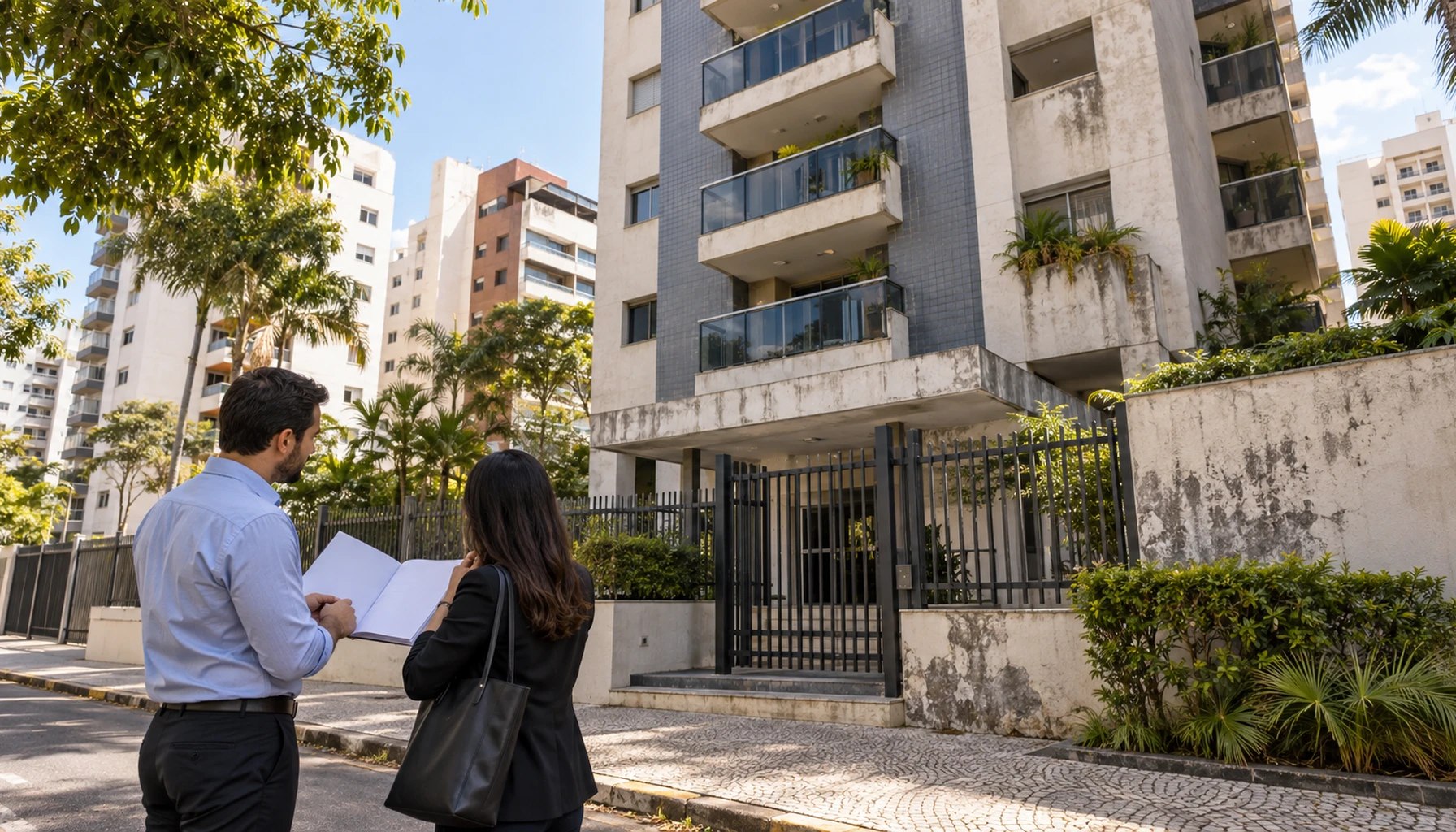
Auction notice and governing rules
Identify the sale method, deadlines, payment conditions, commission, buyer obligations, cancellation provisions, possession terms, and allocation of expenses. A clause from a CAIXA sale, judicial auction, or fiduciary foreclosure should not be transferred automatically to another transaction.
Updated title record and certificates
Review the current matrícula, annotations, registered encumbrances, and relevant certificates with qualified legal counsel. The supplied research did not verify the applicable provisions of the Brazilian Code of Civil Procedure, Article 130 of the National Tax Code, relevant Civil Code provisions, or Superior Court of Justice Theme 1134. This article therefore makes no universal claim about historical condominium or IPTU debt.
Occupancy and possession
Determine whether the property is occupied, by whom, and under what evidence. For fiduciary foreclosure, Article 30 of Brazil’s Law 9,514/1997 permits the acquirer to request preliminary repossession and establishes a 60-day statutory period for vacancy. This rule does not promise physical availability within 60 days in every case.
Article 27 also states that, following title consolidation under Article 26, paragraph 7, the property must be offered at public auction within 60 days. The text accessed on 9 September 2026 indicates wording introduced by Law 14,711/2023. Later amendments, transitional rules, procedural validity, and case facts still require legal review (Law 9,514/1997).
Later amendments, transitional rules, procedural validity, and case facts still require legal review (Law 9,514/1997).
Physical, tax, registry, and credit evidence
Obtain an inspection where access is possible, renovation budgets, and evidence about actual versus registered area, building regularization, urban restrictions, and possible environmental liabilities. If access is unavailable, state that limitation instead of assuming a standard renovation cost.
Confirm the ITBI base and timing under the competent municipality, state notarial and registry schedules, credit approval, interest, total effective cost, disbursement dates, and working-capital needs. These matters were not verified in the supplied sources and require tax, financial, technical, and legal review.
This traceable approach is also discussed in How to Evaluate a Real Estate Market Intelligence Solution.
How should economic discount and return be calculated?
Economic discount compares an independently supported market value with total acquisition cost at a common reference date. It should remain unavailable whenever the valuation or any material cost is unresolved. Return requires a separate full-cycle calculation based on owner capital, net proceeds, exit costs, and dated assumptions.
Estimated economic discount (%) equals independent market value minus total acquisition cost, divided by independent market value, then multiplied by 100.
Use a documented comparable valuation with a defined scope and date. Calculate at full precision, then round the result to one decimal place. If values have different dates, bring them to a common date through a documented method. Never substitute the seller’s reference value without supporting appraisal work.
Carrying cost is the sum, by period, of condominium charges, taxes, insurance, maintenance, interest, fees, and other recurring expenses from acquisition until possession, use, or sale.
The carrying-cost unit is Brazilian reais per operation over the stated holding period. Preserve cents in the working file. If an amount or duration is unknown, use a clearly labeled scenario range or block the total.
Net result equals net sale proceeds or economic use value minus total acquisition cost and additional exit costs.
Simple return (%) equals net result divided by total owner capital contributed, then multiplied by 100.
Both calculations cover the complete investment cycle. Display percentages to one decimal place after calculation at full precision. Declare the cycle duration, do not annualize without dated cash flows, and do not describe simple return as an internal rate of return. Scenario assumptions are not observed facts.
Talk to a specialist
Want to see this applied to your case?
Instead of finishing the article and staying in theory, send us your situation on WhatsApp. We reply with the concrete next step.
What should happen when material information is missing?
When material information is missing, the defensible result may be “wait.” An absent title record, uncertain occupancy, unavailable inspection, or undefined debt allocation can change cost, timing, and risk. The analyst should identify the missing evidence, keep affected calculations blocked, and avoid a forced recommendation.
| Status | Evidence condition | Decision implication |
|---|---|---|
| Advance | Material documents and major costs are supported, with no unresolved blocker identified by specialist review | Continue to detailed diligence and scenario testing, not automatically to a bid |
| Wait | A material input can be obtained but remains missing | Request the document, quotation, or review and keep the calculation blocked |
| Reject | A documented constraint conflicts with the acquisition mandate or risk limit | Record the evidence and remove the lot from the active pipeline |
The logic resembles a real estate feasibility study before buying land in Brazil: both decisions depend on legal, technical, market, and financial evidence before capital is committed.

Is there a minimum safe discount for a property auction?
No universal minimum safe discount is supported by the reviewed evidence. A nominal percentage cannot account consistently for unknown costs, uncertain timing, legal exposure, physical defects, and an unsuitable reference value across different properties. Any acceptable margin must arise from lot-specific evidence, scenarios, and the buyer’s documented risk limits.
The research also found no comparable evidence showing that auction purchases generally outperform the market after selection effects, delays, risk, and full-cycle costs. A broad claim of superior return would therefore be unsupported.
The listing can nominate a candidate. Only lot-level due diligence can test whether the apparent opportunity survives a complete cost, timing, and risk analysis.
Sources and limitations
- Presidency of the Republic of Brazil, Law No. 9,514 of 20 November 1997, Articles 26, 27, and 30. Current text accessed 9 September 2026.
- Caixa Econômica Federal, Regras da Venda Online, Imóveis CAIXA, item 17.1.4. Accessed 9 September 2026; publication date and version not confirmed.
- Caixa Econômica Federal, 2024 notices EL00280224CPARE, EL00410224CPARE, and EL01030224CPARE. Accessed 9 September 2026; historical and transaction-specific.
This article supplies an analytical framework, not legal, tax, financial, engineering, or appraisal advice. Specialist review remains necessary for the specific lot and transaction method.
FAQ
What are the risks of buying a property at auction in Brazil?
The main risks are undisclosed total costs, unresolved liens, outstanding charges, occupancy, litigation, needed repairs, and delays before use or resale. The listing discount alone does not measure economic gain. Review the auction notice, current title record, certificates, occupancy status, technical condition, and buyer-assigned obligations before recommending a bid.
How long does an occupant have to vacate an auctioned property in Brazil?
There is no single deadline applicable to every Brazilian property auction. For extrajudicial auctions arising from fiduciary transfer, Article 30 of Law 9,514/1997 provides a preliminary repossession mechanism with 60 days for vacancy. Judicial auctions and different contractual circumstances require separate legal review of the proceeding, notice, and current law.
How do I find out why a property is being auctioned?
The auction notice and underlying proceeding identify the legal and contractual basis for the sale. Check whether the transaction is judicial, extrajudicial, or another sales modality, then reconcile the notice with the current title record and relevant case documents. Missing or inconsistent evidence should pause the analysis rather than be treated as harmless.
What documents should be checked before bidding on an auction property?
A defensible review starts with the current auction notice, title record, certificates, applicable sales rules, and documents establishing occupancy and debts. Teams should also obtain an independent valuation, technical repair estimates, municipal tax information, registry costs, and financing terms. Each document needs a date, source, scope, and consistency check.
Which costs can exist beyond the winning bid at a property auction?
Total acquisition cost can include the bid, commission, transfer tax, registry fees, buyer-assigned debts, document regularization, vacancy proceedings, repairs, financing, and carrying expenses. The applicable auction notice determines many obligations. Any material amount not yet verified should remain marked “not assessed,” never entered as zero in the investment model.
Does a large advertised discount guarantee a profitable property-auction investment?
A large advertised discount does not guarantee profit because it compares the bid with a seller-selected reference value, not necessarily independent market value or total acquisition cost. Economic discount should be calculated only after documenting market value and all material expenses. Profitability also depends on timing, exit costs, occupancy, financing, and realized revenue.
What’s the best way to compare auction opportunities with incomplete data?
The best method is a lot-specific evidence matrix that separates verified facts, documented scenarios, unknown inputs, and legal or technical review items. Apply consistent formulas, dates, and cost categories across properties, but do not force comparability when modalities differ. A missing material input should trigger further diligence, rejection, or a documented pause.
Related reading
Talk to a specialist
Have a real case to solve?
Message Imovitec on WhatsApp. We reply fast and already speak your context — no forms, no waiting.
Frequently asked questions
What are the risks of buying a property at auction in Brazil?
The main risks are undisclosed total costs, unresolved liens, outstanding charges, occupancy, litigation, needed repairs, and delays before use or resale. The listing discount alone does not measure economic gain. Review the auction notice, current title record, certificates, occupancy status, technical condition, and buyer-assigned obligations before recommending a bid.
How long does an occupant have to vacate an auctioned property in Brazil?
There is no single deadline applicable to every Brazilian property auction. For extrajudicial auctions arising from fiduciary transfer, Article 30 of Law 9,514/1997 provides a preliminary repossession mechanism with 60 days for vacancy. Judicial auctions and different contractual circumstances require separate legal review of the proceeding, notice, and current law.
How do I find out why a property is being auctioned?
The auction notice and underlying proceeding identify the legal and contractual basis for the sale. Check whether the transaction is judicial, extrajudicial, or another sales modality, then reconcile the notice with the current title record and relevant case documents. Missing or inconsistent evidence should pause the analysis rather than be treated as harmless.
What documents should be checked before bidding on an auction property?
A defensible review starts with the current auction notice, title record, certificates, applicable sales rules, and documents establishing occupancy and debts. Teams should also obtain an independent valuation, technical repair estimates, municipal tax information, registry costs, and financing terms. Each document needs a date, source, scope, and consistency check.
Which costs can exist beyond the winning bid at a property auction?
Total acquisition cost can include the bid, commission, transfer tax, registry fees, buyer-assigned debts, document regularization, vacancy proceedings, repairs, financing, and carrying expenses. The applicable auction notice determines many obligations. Any material amount not yet verified should remain marked “not assessed,” never entered as zero in the investment model.
Does a large advertised discount guarantee a profitable property-auction investment?
A large advertised discount does not guarantee profit because it compares the bid with a seller-selected reference value, not necessarily independent market value or total acquisition cost. Economic discount should be calculated only after documenting market value and all material expenses. Profitability also depends on timing, exit costs, occupancy, financing, and realized revenue.
What’s the best way to compare auction opportunities with incomplete data?
The best method is a lot-specific evidence matrix that separates verified facts, documented scenarios, unknown inputs, and legal or technical review items. Apply consistent formulas, dates, and cost categories across properties, but do not force comparability when modalities differ. A missing material input should trigger further diligence, rejection, or a documented pause.
Imovitec
Turn data into next steps.
Take the Imovitec diagnostic and see where your best opportunities are.