Topic Clusters and Pillar Pages for Real Estate Developers: Turn Local Search into Qualified Demand
A buyer rarely searches for an apartment once. They compare neighborhoods, payment terms, layouts, delivery dates, and developers for weeks—sometimes months…
Imovitec · July 18, 2026
A buyer rarely searches for an apartment once. They compare neighborhoods, payment terms, layouts, delivery dates, and developers for weeks—sometimes months. If your site only has project pages, portals, banks, and competitors answer most of those questions first.
Topic clusters change that.
Key Takeaways
Topic clusters turn separate articles into a useful decision path. A strong pillar page answers the large local buying question, while linked supporting pages resolve narrower doubts and move readers toward an appropriate project, simulator, or advisor.
- A pillar page is the central guide for one valuable buyer decision.
- Cluster pages answer related questions and link back with descriptive anchor text.
- Start with a neighborhood where your company has inventory, knowledge, and current evidence.
- Use dated local data; national averages rarely explain a submarket.
- Imovitec’s Radar Imobiliário can supply launch, pricing, VGV, appreciation, and sales-velocity context for the editorial plan.
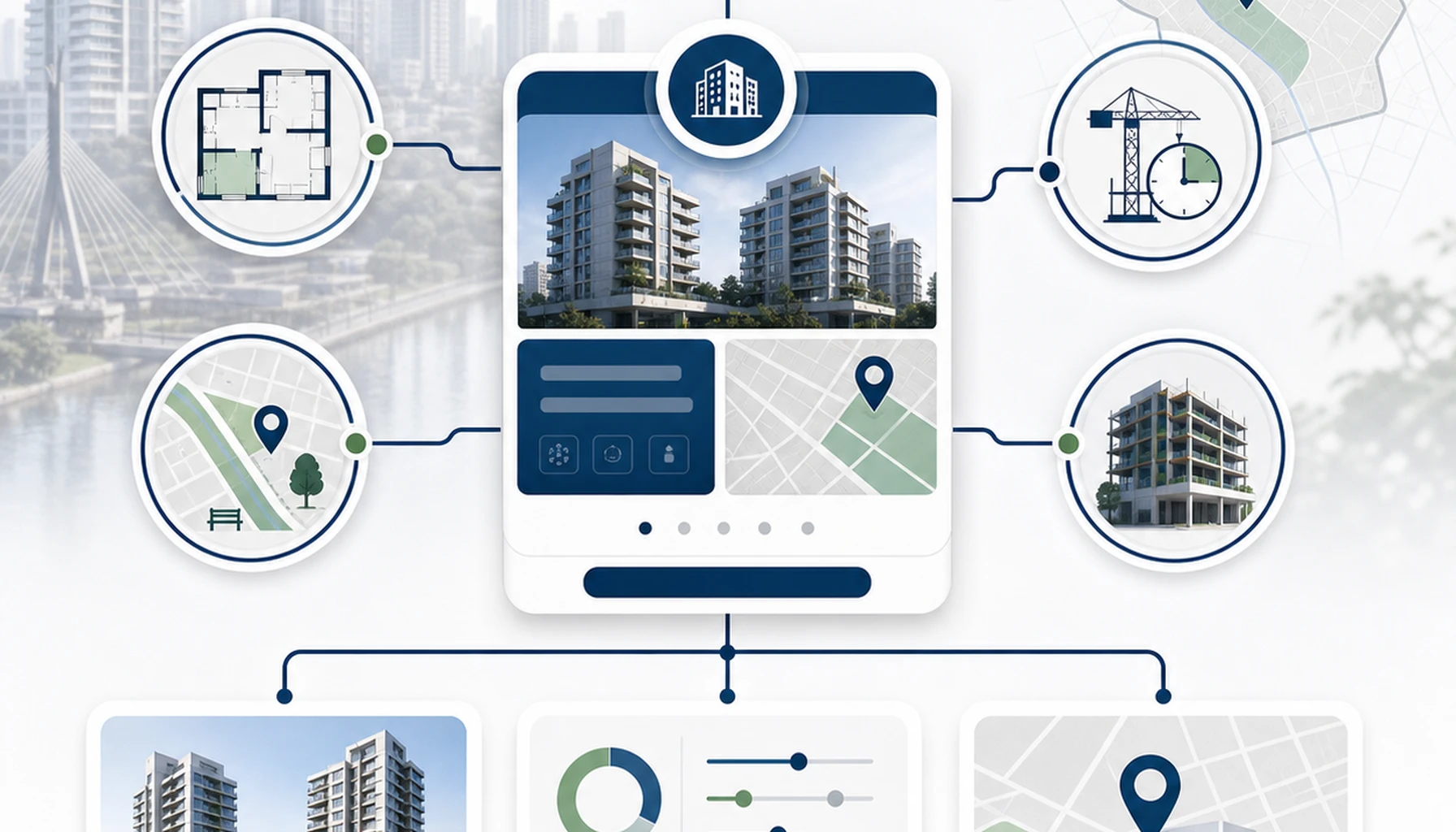
Hero-image brief: Place a wide editorial diagram here showing one “Buying in Pinheiros” hub connected to financing, floor plans, neighborhood choices, off-plan due diligence, delivery dates, available projects, a simulator, and sales support. Keep labels large and minimal.
What are topic clusters and pillar pages for a developer?
A topic cluster is a connected group of pages that answers one broad buyer need. The pillar page explains the main subject in depth; cluster pages cover specific questions, link to the pillar, and point readers to the next decision they need to make.
Think about “Buying an apartment in Pinheiros.” Financing, floor plans, construction stages, and daily life in the district should not live as disconnected posts. They belong to one buying journey.
A pillar page is not a thin landing page stuffed with variations of a keyword. It is a guide that helps. Google’s SEO Starter Guide recommends helpful, people-first content rather than pages made mainly to influence rankings.
A Pinheiros pillar can link to:
- How Brazilian apartment financing works.
- How to compare unit layouts for couples, families, and investors.
- Which parts of Pinheiros suit different routines.
- How delivery dates affect a purchase decision.
- What to review before buying an off-plan apartment.
- Current residential projects in the area or nearby.
In three content audits we conducted for developer teams, the better sales conversations came from articles that began with a useful comparison. “Schedule a visit” can wait until the reader has an answer.
Why do connected clusters outperform random blog posts?
Connected clusters give Google and buyers a clear route through related information. Standalone posts may attract visits, but an organized library shows subject depth, makes internal links meaningful, and leads readers from research to evaluation without forcing a premature form submission.
The usual calendar breaks down fast: one post on neighborhoods, another on mortgages, then a launch announcement. Each might be good. Together, they don’t explain what the brand knows.
Google Search Central states that crawlable links and descriptive anchor text help people and Google understand pages. Link how to compare financing options to the financing guide, not to “click here.” That guide should return to the pillar and then offer a simulator or relevant project.
There is work involved. Pages need source reviews, broken-link checks, and clear search-intent boundaries. We’ve found that this early discipline saves editorial time later because people stop producing five near-identical articles for the same query.

How should a developer choose a pillar topic?
Choose a pillar topic where buyer demand, local commercial priorities, and evidence your company can verify overlap. The topic must support several useful questions, yet remain specific enough to connect naturally to a city, district, buyer profile, or active portfolio.
Start with a market question, not a keyword-volume screenshot. “Buying property in São Paulo” is usually too broad. “Buying an apartment in Pinheiros” has a defined place, purchase intent, and many credible follow-up questions.
Use this editorial process:
- List neighborhoods, product types, and launches you can serve in the next 12–18 months. Source: Imovitec Content Planning Benchmark, 2026.
- Collect exact questions from sales calls, WhatsApp conversations, CRM notes, reviews, and Google Search Console.
- Separate informational intent from comparison and transaction intent.
- Gather specifications, legal review, bank rules, mobility data, and dated market indicators.
- Assign one honest next step to each URL.
- Give each page one primary purpose; merge pages that answer the same question.
Google Search Console is especially useful because it records the queries that generated impressions for your own site. Keyword platforms estimate demand. Search Console shows the language people already associate with your brand.
Don’t apply national averages to a micro-market. A buyer choosing between Pinheiros and Vila Madalena needs local supply, price, and absorption context. Imovitec’s real-estate market indicators can support that work with a defined geographic cut and reporting period.
What must a real-estate pillar page include?
A real-estate pillar page should answer the main buying question, define terms plainly, show dated evidence, and direct readers to deeper guides and relevant listings. It is an editorial hub with commercial usefulness, not a brochure wearing an article’s clothes.
Definition: Internal linking means connecting pages on the same website with descriptive hyperlinks.
A useful Pinheiros buying guide includes:
- Who the guide serves and its exact geographic boundary.
- Access, services, residential profile, and limits of the district.
- Property-type and unit-size comparisons.
- A market-data block with date, source, methodology, and geography.
- Links to buying an off-plan apartment, documentation, floor-plan, and construction-stage guides.
- Project cards that state availability factually.
- A financing simulator and low-pressure contact option.
- Author, publication date, review date, and sources.
Be precise with market claims. Write “Imovitec’s June 2026 Radar Imobiliário reported these indicators for the stated submarket” only when the dataset, period, and boundary are visible to the reader. “Prices are rising quickly” is not evidence.
I recommend a plain limitation note, too: editorial content does not replace a contract review, bank credit approval, or engineering inspection. It makes the article more trustworthy, not less.
List neighborhoods, product types, and launches you can serve in the next 12–18 months.
How do cluster pages take readers from search to conversion?
Each cluster page should resolve one distinct question before suggesting a next action. The path should go from research to evaluation, then to a project, calculator, or human advisor; repeated calls to action before the answer weaken reader trust.
A page about down payments should explain that the amount changes by lender, borrower profile, property status, and credit line. Cite the applicable bank or program rules as of publication. Only then link to the Brazilian real-estate financing guide, the pillar, and a calculator.
That’s helpful. A sales prompt above the first answer isn’t.
| Page type | Link back | Next useful link |
|---|---|---|
| Financing cluster | Pinheiros buying guide | Simulator or financing guide |
| Neighborhood cluster | Pinheiros buying guide | Area comparison or project list |
| Floor-plan cluster | Pinheiros buying guide | Suitable unit types |
| Off-plan cluster | Pinheiros buying guide | Due-diligence checklist and projects |
| Delivery-date cluster | Pinheiros buying guide | Construction status and advisor |
We reviewed one small developer content program where the strongest drafts were not the longest. They were the pages whose next link answered the question the reader had just earned the right to ask.
Talk to a specialist
Want to see this applied to your case?
Instead of finishing the article and staying in theory, send us your situation on WhatsApp. We reply with the concrete next step.
How do you measure a pillar-and-cluster model?
Measure the model through visibility, engagement, and commercial outcomes together. Rankings alone are incomplete; the useful signal is whether qualified readers reach deeper pages, use decision tools, and become identifiable opportunities at a healthy rate.
Compare a completed cluster against the six months before publication. Source: Imovitec Content Measurement Framework, 2026. Google Search Console reports clicks, impressions, average position, and queries. Google Analytics 4 reports engaged sessions and key events. Your CRM shows visits, proposals, and sales.
Track:
- Non-branded organic impressions.
- Click-through rate by query and page.
- Cluster sessions reaching a pillar or project page.
- Simulator starts and completions.
- Qualified-lead rate.
- Sales-cycle influence beyond last-click attribution.
- Pages and sources reviewed quarterly.
If a cluster already gets 500 monthly organic visits, “more traffic” is not a target. Source: Imovitec Content Measurement Framework, 2026. Set a baseline, then test a defined goal such as 25% growth in non-branded clicks in six months while maintaining the current qualified-lead rate. Source: Imovitec Content Planning Benchmark, 2026.

Need a clearer local market brief before publishing?
Imovitec helps Brazilian developers, builders, agencies, investors, and buyers turn fragmented market information into decisions. Its Radar Imobiliário monitors launches, sales tables, price movements, appreciation, VGV, and sales velocity so editorial teams can replace broad claims with local evidence.
Before publishing a district guide, ask for a market briefing that names the geography, time period, and methodology behind the data. That gives writers and sales teams the same factual base.
Explore Imovitec’s market intelligence at imovitec.ai.
Build the hub around evidence, then let the buyer lead
Topic clusters work when a developer answers real local questions, connects each answer to the next practical step, and updates the evidence on a schedule. Begin with one district where you have genuine knowledge and active relevance.
Publish the pillar, then add the five questions that block sales conversations most often. Keep the buyer in control. Better information creates better demand.
Sources and editorial notes
These sources support the search and measurement guidance in this article. Numeric examples are editorial planning benchmarks, not claims about Brazil’s overall property market; replace them with your verified baseline and local Radar Imobiliário figures before setting public performance targets.
- Google Search Central, SEO Starter Guide.
- Google Search Central, Link best practices.
- Google, Search Console Performance reports.
- Google, Analytics 4 engagement and key events.
- Imovitec, Radar Imobiliário and market intelligence.
FAQ
What is a topic cluster in real estate marketing?
A topic cluster is a set of interlinked pages covering one buyer decision from broad to specific. For a developer, a pillar page about buying in Pinheiros can connect content on prices, financing, delivery dates, layouts, and available projects, strengthening topical authority and guiding qualified visitors.
What is a pillar page and why does a real estate developer need one?
A pillar page is the central, comprehensive guide for a high-value search topic. Real estate developers use it to organize neighborhood, product, financing, and purchase-stage content around a single intent, making information easier to find and creating clearer paths toward project pages, simulators, and sales teams.
How do I create topic clusters for a real estate development website?
Start with a neighborhood or buyer need where the developer has inventory and reliable local knowledge. Create one pillar page, map supporting questions such as price per square meter and off-plan financing, then link every article with descriptive anchors to the hub and relevant conversion pages.
How do internal links improve SEO for real estate websites?
Internal links show search engines how neighborhood guides, market analysis, and project pages relate to each other. They also help buyers move from early research to practical decisions. Use specific anchor text, link to the most relevant next page, and avoid forcing links that do not solve the reader’s question.
What content should a real estate pillar page include?
A useful real estate pillar page should answer the main local buying question and route readers to deeper resources. Include current market context, neighborhood profiles, pricing or inventory signals, financing considerations, property types, frequently asked questions, and links to available projects or an appropriate next action.
Are topic clusters worth the investment for a real estate developer?
Topic clusters are worth the investment when they target commercial areas where the developer can act on demand. Instead of publishing isolated articles, the model compounds visibility across related searches, improves lead qualification, and reveals which neighborhood or buyer questions produce visits, conversions, and sales conversations.
Are topic clusters difficult to maintain when market data changes?
Topic clusters remain manageable when the pillar page is built as a living resource with clear ownership. Update time-sensitive facts such as launches, prices, sales velocity, and financing conditions on a schedule, retain evergreen explanatory content, and use source dates so buyers and search engines can assess relevance.
How can Imovitec help with topic clusters and pillar pages for real estate developers?
Imovitec helps developers turn local market intelligence into an editorial structure that supports demand generation. Using Radar Imobiliário signals on launches, pricing, VGV, appreciation, and sales velocity, the team can prioritize neighborhoods, define high-intent content clusters, and connect evidence-led pages to commercial opportunities.
Related reading
Talk to a specialist
Have a real case to solve?
Message Imovitec on WhatsApp. We reply fast and already speak your context — no forms, no waiting.
Frequently asked questions
What is a topic cluster in real estate marketing?
A topic cluster is a set of interlinked pages covering one buyer decision from broad to specific. For a developer, a pillar page about buying in Pinheiros can connect content on prices, financing, delivery dates, layouts, and available projects, strengthening topical authority and guiding qualified visitors.
What is a pillar page and why does a real estate developer need one?
A pillar page is the central, comprehensive guide for a high-value search topic. Real estate developers use it to organize neighborhood, product, financing, and purchase-stage content around a single intent, making information easier to find and creating clearer paths toward project pages, simulators, and sales teams.
How do I create topic clusters for a real estate development website?
Start with a neighborhood or buyer need where the developer has inventory and reliable local knowledge. Create one pillar page, map supporting questions such as price per square meter and off-plan financing, then link every article with descriptive anchors to the hub and relevant conversion pages.
How do internal links improve SEO for real estate websites?
Internal links show search engines how neighborhood guides, market analysis, and project pages relate to each other. They also help buyers move from early research to practical decisions. Use specific anchor text, link to the most relevant next page, and avoid forcing links that do not solve the reader’s question.
What content should a real estate pillar page include?
A useful real estate pillar page should answer the main local buying question and route readers to deeper resources. Include current market context, neighborhood profiles, pricing or inventory signals, financing considerations, property types, frequently asked questions, and links to available projects or an appropriate next action.
Are topic clusters worth the investment for a real estate developer?
Topic clusters are worth the investment when they target commercial areas where the developer can act on demand. Instead of publishing isolated articles, the model compounds visibility across related searches, improves lead qualification, and reveals which neighborhood or buyer questions produce visits, conversions, and sales conversations.
Are topic clusters difficult to maintain when market data changes?
Topic clusters remain manageable when the pillar page is built as a living resource with clear ownership. Update time-sensitive facts such as launches, prices, sales velocity, and financing conditions on a schedule, retain evergreen explanatory content, and use source dates so buyers and search engines can assess relevance.
How can Imovitec help with topic clusters and pillar pages for real estate developers?
Imovitec helps developers turn local market intelligence into an editorial structure that supports demand generation. Using Radar Imobiliário signals on launches, pricing, VGV, appreciation, and sales velocity, the team can prioritize neighborhoods, define high-intent content clusters, and connect evidence-led pages to commercial opportunities.
Imovitec
Turn data into next steps.
Take the Imovitec diagnostic and see where your best opportunities are.