How to Build a Competitive Study for a Property Launch: Variables, Sources, and Limits
A property-launch competitive study is a dated, traceable comparison of developments that may influence product, positioning, or pricing decisions for a…
Imovitec · September 27, 2026
A property-launch competitive study is a dated, traceable comparison of developments that may influence product, positioning, or pricing decisions for a proposed launch.
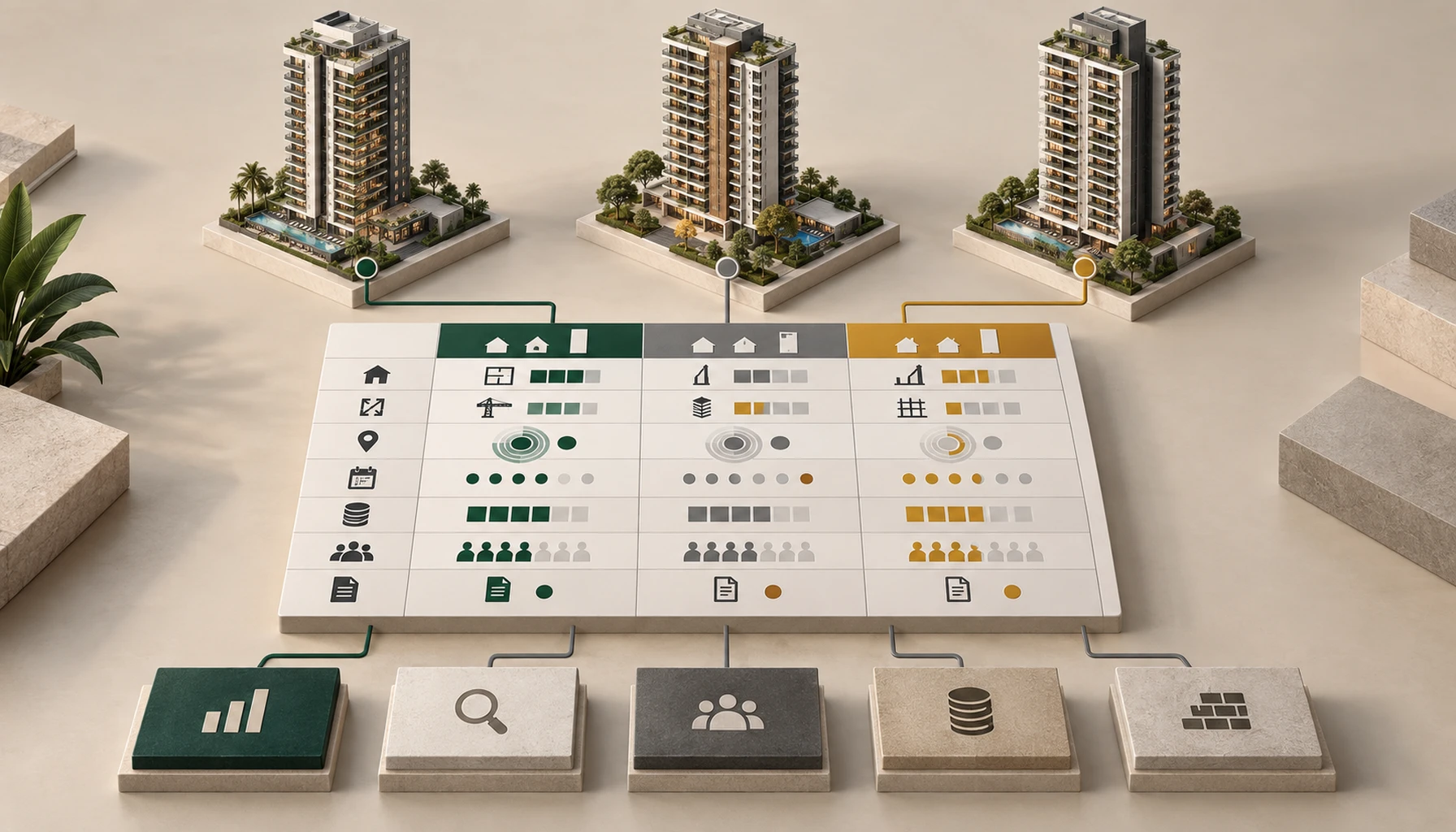
Its purpose is not to accumulate listings. It should establish which projects are genuinely comparable, what each source measures, and where the evidence stops supporting a conclusion.
False precision is the central risk. Duplicate advertisements can look like multiple available units. An asking price can be mistaken for a closing price, while inventory from one geography or period may be compared with sales from another. A polished spreadsheet does not correct these conceptual mismatches.
Key takeaways
A defensible competitive study needs comparability, traceability, and sufficient evidence. Align geography, period, product, stage, and commercial conditions; record a source and observation date for every material field; and disclose valid records, denominators, exclusions, missing data, and unresolved definitions before making a recommendation.
- Keep primary-market activity, advertised prices, demographics, credit, and construction costs in separate evidence layers.
- Record the source and observation date for every development and unit.
- Remove identifiable duplicates before calculating an asking-price statistic.
- Treat advertised price per square metre as a positioning reference, not proof of a closing price or appraisal value.
- Calculate sales velocity only when the selected source documents its formula, denominator, period, and coverage.
- Block conclusions when geography, period, coverage, or definitions cannot be reconciled.
What question should the competitive study answer?
The study should support a defined decision: whether a site deserves deeper validation, which unit mix should be tested, or which advertised-price range needs commercial review. It cannot prove demand, affordability, margin, achieved prices, or future absorption unless evidence designed for those questions is also available.
Start with a written decision statement. Identify the development concept, geographic influence area, observation window, and product attributes that may change. This scope keeps the analysis focused during the weeks or months available for preliminary assessment, site validation, or launch preparation.
For related frameworks, read How to Compare Property Launches Before Deciding Your Next Development and Real Estate Competitive Analysis: Which Variables Position a New Development?.
Which competitors are actually comparable?
A comparable competitor is a development whose location, observation period, product, area range, stage, and commercial context are sufficiently aligned with the proposed launch. This is an editorial method, not an official market classification. Projects that fail a material test can still provide context, but should not enter the main calculation unnoticed.
Concise definition: A comparable competitor is a project that passes the study’s documented geography, time, product, stage, and commercial-basis tests.
Separate candidates into two groups:
- Direct competitors pass the principal filters and may enter calculations.
- Indirect competitors may influence buyer choice but fail at least one material filter, so they remain contextual.
Apply six comparability gates
Document the following for every candidate:
- Geography: the same micromarket, or a separately justified influence area.
- Time: the same observation date, or an explicit collection window.
- Product: unit type, private area, bedrooms, parking, standard, and relevant amenities.
- Stage: prelaunch, launch, under construction, or completed inventory.
- Commercial basis: gross list price, stated discount, payment schedule, included parking or storage, and other identifiable conditions.
- Evidence quality: primary document, institutional research, listing, or secondary report.
If a record fails a gate, retain it as contextual evidence or exclude it. Do not relax the criteria solely to enlarge the sample.
Which variables belong in the inventory?
The minimum inventory should make each row independently auditable. Record the development, developer, location, stage, documented launch date, unit type, private area, bedrooms, parking, asking price, asking price per square metre, commercial conditions, launched units, sold units, available units, source, and observation date.
This structure is an editorial recommendation, not an official taxonomy. Each field needs its own provenance. A developer’s sales table may support area and list price without proving achieved sales. A portal advertisement may not establish that a unit remains available.
Use explicit evidence states:
| State | Meaning |
|---|---|
| Observed | The source provides the field and its observation date. |
| Derived | A documented calculation uses observed inputs. |
| Not available | The field was not found. |
| Not comparable | The field exists but fails a comparability gate. |
| Unknown definition | The source publishes a metric without enough methodology. |
Never convert “not available” into zero. Zero is a measured value; missingness is an evidence condition.
Which sources can be combined, and which must remain separate?
Different sources may inform one decision without measuring the same universe. Based on the official source descriptions reviewed, primary-market activity, advertised prices, demographic context, credit conditions, and construction costs should remain separate evidence layers. Combining them requires explicit reconciliation of concept, geography, date, unit, and coverage.

Primary-market activity
The ABRAINC-Fipe Indicator reports monthly launches, sales, deliveries, final supply, and cancellations in the primary market. The Fundação Instituto de Pesquisas Econômicas and Associação Brasileira de Incorporadoras Imobiliárias pages confirm those subjects and the monthly frequency.
The competent report, participating-company coverage, full methodology, and revision history were not verified in the supplied evidence. Attach and review the relevant report before citing any figure.
Sources: Fundação Instituto de Pesquisas Econômicas, “Indicadores Abrainc/Fipe,” page located September 27, 2026, Fipe; Associação Brasileira de Incorporadoras Imobiliárias, “Indicador Mensal: ABRAINC-Fipe,” accessed September 27, 2026, ABRAINC.
Advertised prices
The FipeZAP Index draws on samples of sale and rental advertisements. It measures advertised prices, not completed transaction prices. Before using it in a local comparison, verify municipal coverage, filters, sample composition, duplicate treatment, and the report for the relevant period.
Sources: Fundação Instituto de Pesquisas Econômicas, “Índice FipeZAP,” result dated September 14, 2026 and accessed September 27, 2026, FipeZAP; Fipe, “Metodologia do Índice FipeZAP,” 2019, accessed September 27, 2026, methodology PDF. The 2019 document may not be the methodology in force in 2026.
See How to Read a Competitor’s Sales Table Without Confusing List Price with Realized Price.
Demographic context
The 2022 Brazilian Census and SIDRA, maintained by the Instituto Brasileiro de Geografia e Estatística, can supply demographic, household, and income context. Each extraction should record its table code, variable, classification, unit, and territorial level.
Census results are a dated population snapshot. They do not automatically represent current demand or purchasing power.
Source: Instituto Brasileiro de Geografia e Estatística, “Censo Demográfico 2022” and SIDRA, 2022 reference period with release dates varying by table, accessed September 27, 2026, SIDRA.
For temporal change, divide the value in period t by the base-period value, subtract 1, and multiply by 100.
Construction costs
SINAPI, produced by the Instituto Brasileiro de Geografia e Estatística and Caixa Econômica Federal, publishes construction costs and indices. It can provide cost context after aligning state, period, standard, and charges.
SINAPI does not represent sale price, gross development value, margin, total development cost, or a project-specific budget.
Source: Instituto Brasileiro de Geografia e Estatística and Caixa Econômica Federal, “Sistema Nacional de Pesquisa de Custos e Índices da Construção Civil,” monthly publication, specific reference month not recovered, accessed September 27, 2026, SINAPI.
Credit data must also remain separate. The Selic rate, mortgage rates, and financing volume under Brazil’s SBPE system are different measures. Current values are intentionally omitted because the required primary pages from Banco Central do Brasil and ABECIP were not recovered in the approved research.
Talk to a specialist
Want to see this applied to your case?
Instead of finishing the article and staying in theory, send us your situation on WhatsApp. We reply with the concrete next step.
How should asking price per square metre be calculated?
For one comparable unit, divide the total advertised price by the advertised private area. Both inputs must come from the same listing and observation date. Express the result in Brazilian reais per square metre, round only the final result, preferably to the nearest R$1/m², and disclose exclusions.
Exclude records without a comparable price or private area. Do not impute missing values. Note whether parking, storage, discounts, or other components are included in the advertised total.
For a group, calculate the median of the individual comparable R$/m² results after deduplication. Keep unit type, stage, area band, micromarket, and collection window consistent.
Publish the valid advertisement count, or n. This denominator represents valid advertisements, not a presumed count of distinct available units. Asking price per square metre is a positioning reference; it does not prove a closing price or appraisal value.
How should inventory mix and absorption be handled?
Calculate a unit type’s observed inventory share by dividing its available units by all available units in the comparable universe, then multiplying by 100. Calculate observed cohort absorption by dividing units sold during the window by units effectively available for sale under the source’s documented definition, then multiplying by 100.
For both measures, use one decimal place and state the observation date or period. Keep geography, definitions, and coverage consistent. Unknown availability cannot be counted as zero.
For absorption, record cancellations, relaunches, and withdrawals when the source includes them. The denominator must follow the selected source’s definition rather than an assumed market convention.
VSO and IVV calculations remain blocked until the selected research publication provides its formula, denominator, period, and scope. The approved evidence did not contain a current official methodological note from Câmara Brasileira da Indústria da Construção or Secovi-SP that would support attributing a generic formula to either organization.
See VSO vs. IVV: Which Indicator to Use, for What Period, and What Neither Measures.

How do you test whether the evidence is sufficient?
Evidence is decision-ready only when another reviewer can reproduce the result and identify its blind spots. Check compatibility across geography, period, product, stage, coverage, and definitions. Then verify field-level provenance, duplicate treatment, known numerators and denominators, visible exclusions, missing records, and the distinction between advertised and achieved prices.
Before presenting a recommendation, confirm:
- Does every material field have a source and observation date?
- Were identifiable duplicate advertisements removed?
- Are the numerator and denominator known?
- Are exclusions and missing records visible?
- Does the conclusion distinguish asking price from achieved price?
- Does every time comparison preserve the same source, concept, coverage, and unit?
For temporal change, divide the value in period t by the base-period value, subtract 1, and multiply by 100. Report the result as a percentage rounded to one decimal place.
Do not join a series across a methodological break unless the source publishes an appropriate treatment. A larger dataset does not cure incompatible definitions.
What are the limits of a launch competitive study?
A competitive study can organize observable market evidence and narrow a decision. By itself, it cannot prove realized prices, present purchasing capacity, financial return, legal feasibility, zoning compliance, or future absorption. Those conclusions require additional primary evidence and review by the relevant financial, legal, privacy, and local-market specialists.
Financial questions involving affordability, effective credit cost, cap rate, internal rate of return, net present value, or interest scenarios need specialist review and additional sources.
Legal and privacy review is required for advertisement data, personal data, promotional claims, registered development status, zoning, and statements about competitors. Local real-estate review should validate the influence area, construction standard, project stage, and division between direct and indirect competition.
The responsible conclusion may therefore be conditional. Evidence might support testing a product or price-positioning hypothesis without supporting final approval.
A reliable study shows what was observed, how it was compared, and which decisions remain blocked.
FAQ
How do I build a competitor study for a property launch?
A reliable competitor study begins by defining the decision, geography, observation period, product type, development stage, and commercial conditions. Create a dated inventory of comparable projects, document every source, deduplicate advertisements, and disclose exclusions and missing fields before using the evidence to recommend product, positioning, or an asking-price range.
What are the main types of competitors for a property launch?
Property-launch competitors should be classified according to how they affect the buyer’s choice, not by a universal fixed count. Direct competitors have comparable location, product, stage, and positioning; indirect competitors satisfy the same demand differently. Projects that fail the stated comparability rules should remain market context rather than enter the analytical sample.
What’s the best way to analyze property-launch competitors effectively?
Effective competitor analysis compares like with like and preserves a traceable evidence trail. Align geography, period, typology, private area, development stage, and commercial conditions. Record the source and observation date for each material field, calculate metrics only from valid records, and report sample size, coverage, exclusions, and unknown values.
How often should a property-launch competitor study be updated?
A competitor study should be updated whenever its evidence may no longer represent the decision date. Define a collection date or window, then refresh prices, availability, construction stage, and commercial conditions before major recommendations. Preserve prior snapshots instead of overwriting them, because dated observations distinguish genuine market changes from collection inconsistencies.
Which sources should be used in a real-estate competitor study?
Use sources according to what each one actually measures. Developer materials can describe individual launches, FipeZAP reflects asking-price advertisements, ABRAINC-Fipe covers reported primary-market indicators, IBGE SIDRA supplies documented demographic tables, and SINAPI contextualizes construction costs. Never treat these datasets as interchangeable, and attach the applicable methodology and reporting period.
Is a detailed competitor study worth the time and cost?
A detailed study is worthwhile when it reduces the risk of recommending a product, position, or asking-price range from duplicated advertisements, incomplete inventory, or incompatible indicators. Its value should be judged against the decision at risk. A smaller, well-documented comparable sample is more defensible than a larger dataset with unknown coverage and provenance.
Can asking prices and public market indicators support a launch pricing decision?
Asking prices and public indicators can support market positioning, but they do not prove closing prices, appraised values, margins, or current demand. Use deduplicated asking-price data as one reference, label its limits, and reconcile concept, geography, period, and coverage before comparison. Unknown transaction evidence should remain explicitly unknown, not inferred.
Talk to a specialist
Have a real case to solve?
Message Imovitec on WhatsApp. We reply fast and already speak your context — no forms, no waiting.
Frequently asked questions
How do I build a competitor study for a property launch?
A reliable competitor study begins by defining the decision, geography, observation period, product type, development stage, and commercial conditions. Create a dated inventory of comparable projects, document every source, deduplicate advertisements, and disclose exclusions and missing fields before using the evidence to recommend product, positioning, or an asking-price range.
What are the main types of competitors for a property launch?
Property-launch competitors should be classified according to how they affect the buyer’s choice, not by a universal fixed count. Direct competitors have comparable location, product, stage, and positioning; indirect competitors satisfy the same demand differently. Projects that fail the stated comparability rules should remain market context rather than enter the analytical sample.
What’s the best way to analyze property-launch competitors effectively?
Effective competitor analysis compares like with like and preserves a traceable evidence trail. Align geography, period, typology, private area, development stage, and commercial conditions. Record the source and observation date for each material field, calculate metrics only from valid records, and report sample size, coverage, exclusions, and unknown values.
How often should a property-launch competitor study be updated?
A competitor study should be updated whenever its evidence may no longer represent the decision date. Define a collection date or window, then refresh prices, availability, construction stage, and commercial conditions before major recommendations. Preserve prior snapshots instead of overwriting them, because dated observations distinguish genuine market changes from collection inconsistencies.
Which sources should be used in a real-estate competitor study?
Use sources according to what each one actually measures. Developer materials can describe individual launches, FipeZAP reflects asking-price advertisements, ABRAINC-Fipe covers reported primary-market indicators, IBGE SIDRA supplies documented demographic tables, and SINAPI contextualizes construction costs. Never treat these datasets as interchangeable, and attach the applicable methodology and reporting period.
Is a detailed competitor study worth the time and cost?
A detailed study is worthwhile when it reduces the risk of recommending a product, position, or asking-price range from duplicated advertisements, incomplete inventory, or incompatible indicators. Its value should be judged against the decision at risk. A smaller, well-documented comparable sample is more defensible than a larger dataset with unknown coverage and provenance.
Can asking prices and public market indicators support a launch pricing decision?
Asking prices and public indicators can support market positioning, but they do not prove closing prices, appraised values, margins, or current demand. Use deduplicated asking-price data as one reference, label its limits, and reconcile concept, geography, period, and coverage before comparison. Unknown transaction evidence should remain explicitly unknown, not inferred.
Imovitec
Turn data into next steps.
Take the Imovitec diagnostic and see where your best opportunities are.