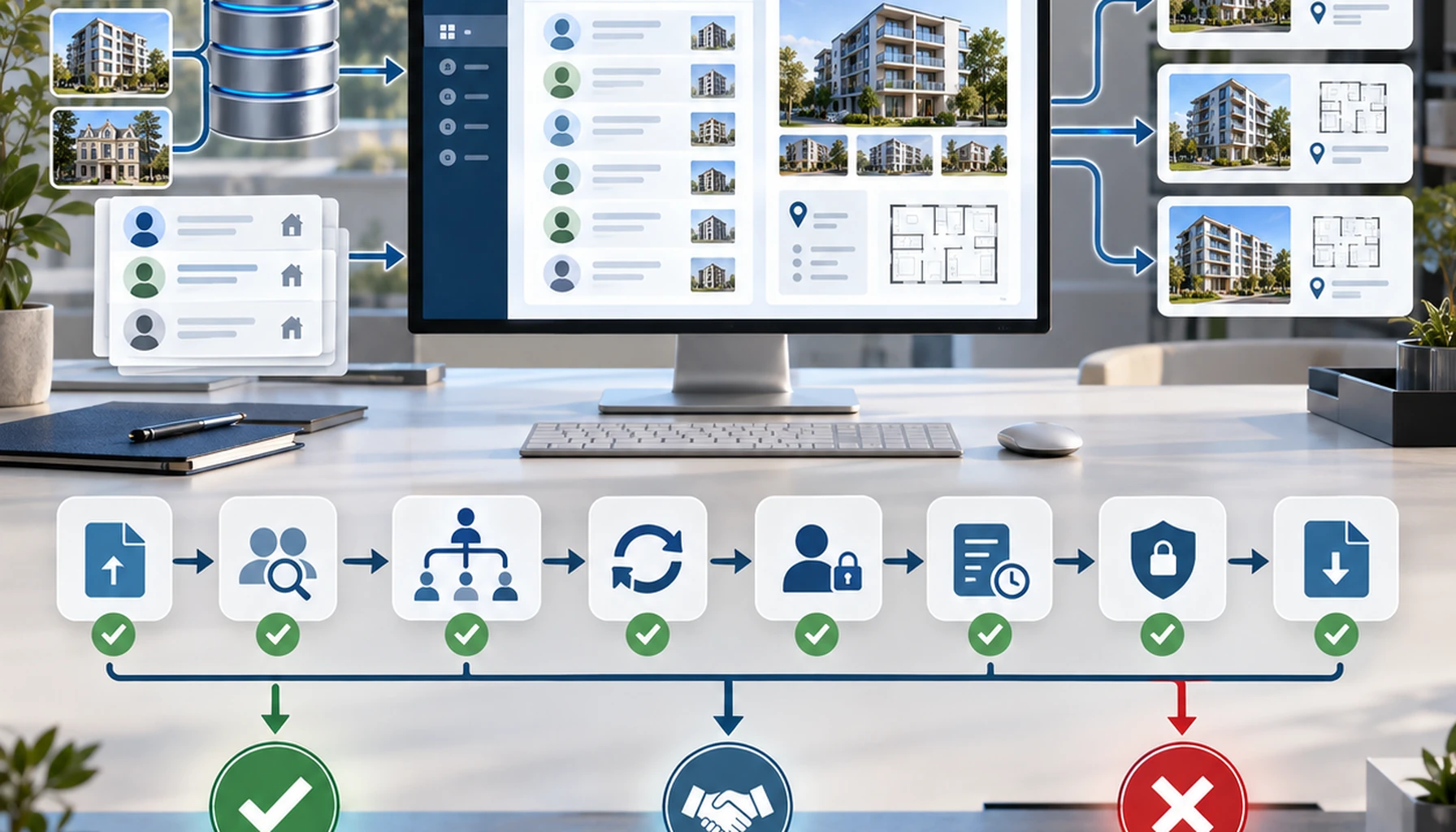
Real Estate CRM: What to Test Before You Sign a Contract
Learn how to test a real estate CRM using controlled data, measurable criteria, security reviews, exports, logs and contract checks before signing.
Imovitec · November 01, 2026
A real estate CRM organizes contacts, properties, interactions, sales stages and follow-up activities. Before selecting one, a brokerage should test whether the proposed configuration preserves its data, follows its operating rules and produces evidence that another reviewer can examine.
A polished demonstration is not enough. A more reliable method is a controlled proof of concept using synthetic or properly authorized data, predefined scenarios, exported records and documented acceptance criteria. The evidence should support one of three decisions: approve, reject or negotiate.
Real estate CRM: a system that records and manages property, contact, interaction, sales-stage and follow-up information.
Key takeaways
A useful CRM assessment tests the configured system against known inputs and expected results. It examines data recovery, operating rules, measurement quality and contract exit without treating individual features as proof of legal compliance. The recommendations below are editorial methods unless a cited source states otherwise.
- Test with a controlled sample and known expected results.
- Compare imported and exported fields, attachments, histories and recorded processing grounds when applicable.
- Use synthetic leads to assess duplicate handling, routing, timestamps and synchronization.
- Review access controls, logs, security, data-subject workflows and exit procedures with the appropriate specialists.
- Calculate indicators only with a declared denominator, period, exclusions and missing-data rule.
- Reject universal performance claims that lack primary evidence or authorized company data with a disclosed method.
What should a real estate brokerage test before choosing a CRM?
A brokerage should test data portability, duplicate handling, lead routing, workflow execution, reporting, permissions, audit evidence, synchronization and contract exit. Each scenario needs a known input, an expected result, evidence, a responsible reviewer and a condition for approval, rejection or negotiation.
This list is a methodological recommendation, not an official regulatory checklist. It suits a commercial manager or sales operations lead selecting, renewing or replacing a system within days or a few weeks.
Begin with the operating decisions that the CRM must support. Then record the evidence needed to show whether the proposed configuration performs as expected. A related evidence-led framework appears in the guide to evaluating a real estate market intelligence solution.
How do you run a controlled proof of concept?
A controlled proof of concept processes known inputs through a limited CRM configuration and compares the outputs with documented expectations. Logs, screenshots and exports should be retained so a second reviewer can check the findings and distinguish verified behavior from assumptions or unresolved questions.
Controlled proof of concept: a limited test that compares known inputs and expected outputs while preserving reviewable evidence.
1. Define the decision first
Write down the operational questions before opening the system. Can the team recover every required record? Are leads assigned under the written rule? Can managers distinguish human service from automation? Does the history reveal meaningful changes? Does an integration failure become visible?
For each scenario, record:
- the input and whether it is synthetic or authorized;
- the expected output;
- the evidence to collect;
- the person responsible for validation;
- the condition for approval, rejection or negotiation.
Do not add arbitrary targets simply to complete the test sheet. The approved research found no primary source establishing a universal real estate CRM benchmark for conversion, response time, availability, productivity or financial return.
2. Test import and export as one cycle
Import a controlled sample containing known identifiers, fields, attachments and histories. When relevant and legally reviewed, include the recorded consent or other documented processing ground linked to a contact. Export the processed sample and compare it with the source.
Check whether identifiers remain stable, fields retain their meaning, attachments can be recovered and histories preserve their sequence. Document missing, transformed and newly created fields.
This is a reproducible editorial protocol, not a legal requirement or recognized certification. It also reveals exit risk. Ask about available formats, field dictionaries, attachment handling, delivery times and termination procedures. Data ownership, return, deletion, migration and restoration evidence require contractual review.
3. Test duplicate handling with synthetic variations
Create synthetic records representing the same contact with controlled changes in telephone number, email formatting and source. Add different people who share only one similar attribute. This sample can reveal both missed matches and incorrect matches without exposing unnecessary personal data.
Calculate the duplicate rate by dividing records identified as duplicates under the documented rule by all records in the tested batch, then multiplying by 100. Report the result as a percentage rounded to one decimal place.
Publish the matching rule with the result. Preserve false positives and false negatives for manual review. If the test covers one import batch, that batch is the denominator, not the whole database. A high or low percentage is not inherently good because sample composition determines the expected result.

4. Test lead routing under known conditions
Send clearly marked synthetic leads at controlled times and document the routing rule in advance. Change only variables used by the proposed configuration, such as property, location, team or schedule.
Compare expected and actual assignments, timestamps and reassignments. Preserve exceptions and manual interventions. This is an operational test without an official sector benchmark.
For longer sales journeys, align CRM stages with the brokerage’s written definitions. The guide to the real estate developer sales funnel offers a related framework, but each organization still needs its own eligibility and stage-entry rules.
Which CRM metrics are valid during the test?
A CRM metric is ready for a purchasing decision only when its event, denominator, observation window, exclusions and treatment of missing data are explicit. The formulas below are analytical recommendations, not market averages, regulatory requirements or evidence that one CRM will improve commercial results.
Conversion from stage A to stage B
Divide unique records entering stage B during the period by unique eligible records entering stage A during the same declared period, then multiply by 100. A cohort-based window is preferable when timing affects eligibility. Round to one decimal place.
Exclude identified tests and marked duplicates. Report records without stable identifiers, and do not infer missing stages.
Application to a brokerage depends on its processing operation and legal review (ANPD guide, accessed November 1, 2026).
Time to first human response
For each eligible lead, subtract the valid lead-entry timestamp from the first valid human-service timestamp. Report the median in minutes or hours and retain the underlying distribution.
Normalize time zones, separate automation from human contact and disclose the share of eligible leads with both timestamps. Do not impute missing times. The median limits the influence of extremes, but no official real estate source in the approved research makes it mandatory.
Claims linking faster responses with better outcomes need authorized organizational evidence and a disclosed method. For broader operational context, see AI real estate CRM for property launches.
Leads without human service
Divide eligible leads without a valid human interaction by the observation deadline by all eligible leads received during the declared window. Multiply by 100 and round to one decimal place.
Exclude tests and spam under a written rule. Treat a missing timestamp as unknown, not automatically as unattended.
Delivery and synchronization
Calculate delivery rate by dividing messages with technical delivery confirmation by messages accepted for sending. Multiply by 100 and round to one decimal place for the declared channel and period.
Keep sent, accepted, delivered, read, rejected and unknown statuses separate. Delivery is not evidence of reading or response.
Calculate synchronization error rate by dividing confirmed failed items by attempted synchronization items. Multiply by 100 and round to one decimal place for the batch or period.
Use correlation identifiers from both systems. Separate repeated attempts, delays, rejections and loss. Absence of a log is unknown, not evidence of success.

How should LGPD and security affect the decision?
An LGPD review should identify the applicable purposes, legal grounds, notices, retention rules, sharing arrangements and organizational responsibilities. A CRM field, consent option, export function or encryption statement cannot, by itself, establish compliance with Brazil’s General Data Protection Law.
The Brazilian National Data Protection Authority, formally the Autoridade Nacional de Proteção de Dados, explains that legitimate interest requires a specific assessment involving purpose, necessity, reasonable expectations and safeguards. It is not automatic permission to collect, import or reuse contacts. Application to a brokerage depends on its processing operation and legal review (ANPD guide, accessed November 1, 2026).
During the proof of concept, examine user profiles, access restrictions, logs, export support and workflows for data-subject requests. These checks are operational inferences from data-protection themes, not a verified compliance checklist.
Security specialists should separately assess multifactor authentication, access profiles, audit trails, encryption, vulnerability management, backups, restoration and incident response. Ask for evidence, scope and limitations. A vendor feature list does not support a compliance conclusion.
Talk to a specialist
Want to see this applied to your case?
Instead of finishing the article and staying in theory, send us your situation on WhatsApp. We reply with the concrete next step.
What should be verified about integrations and availability?
Accept an integration only after a controlled record can be traced across both systems through identifiers, timestamps, failures and retries. The approved research did not verify official public documentation for integrations with Brazilian property portals, so each claimed capability remains unverified until the portal and vendor provide suitable evidence.
Observed availability is the number of eligible minutes minus unavailable minutes, divided by eligible minutes, then multiplied by 100. The percentage should cover a declared contractual window and use precision compatible with the proposed service-level agreement.
Use independent monitoring. Treat monitoring gaps as unknown and exclude maintenance only when the contract permits it. A short proof of concept cannot establish a long-term availability record.
Compare the proposed SLA definition, exclusions, maintenance rules, support process and remedies. These are contractual matters requiring specialist review.
When should a brokerage approve, reject or negotiate?
Approve when critical scenarios pass, the evidence is reproducible and specialists find the remaining risks acceptable. Reject when essential data, operating or exit requirements fail. Negotiate when configuration, implementation duties, additional evidence or contractual language can address a clearly defined gap.
The final decision record should contain the protocol, results, logs, exports, measurement coverage, known unknowns and legal, security and contractual review points. It should identify every claim that remains unverified.
The goal is narrow and practical: determine whether the tested configuration and proposed contract support this brokerage’s documented operation. No verified Imovitec offer or appropriate next action was supplied for this decision, so this article deliberately contains no commercial CTA.
Sources and limitations
The evidence package supports limited legal context and a set of editorial testing methods. It does not support universal CRM benchmarks, claims of LGPD compliance, named portal integrations or promised commercial results. Legal, security and contractual conclusions therefore require specialist review before procurement or publication.
- Autoridade Nacional de Proteção de Dados, “Hipóteses legais de tratamento de dados pessoais: legítimo interesse,” publication date not confirmed, accessed November 1, 2026. Official ANPD guide. The retrieved evidence confirmed the balancing-test summary, but not complete metadata or every page.
- Ministry of Development and Social Assistance, Family and Fight Against Hunger, “Lei Geral de Proteção de Dados Pessoais (LGPD),” undated page, accessed November 1, 2026. Official introductory page. It does not replace consolidated Law 13,709/2018 or guidance from the ANPD.
- The approved research did not fully verify the consolidated LGPD text, current incident-reporting rules, complete technical guidance or official portal-integration documentation.
FAQ
How do I test how a real estate CRM works before signing a contract?
Test a configured real estate CRM with synthetic or properly authorized records, predefined scenarios and expected outcomes. Run lead entry, assignment, follow-up, deduplication and export workflows. Preserve logs and exported results so reviewers can compare actual behavior with documented acceptance criteria and decide whether to approve, reject or negotiate.
What is a real estate CRM, and what should it manage?
A real estate CRM records and manages contacts, properties, interactions, sales stages and follow-up activities. During evaluation, confirm that the configured system preserves required fields, histories and identifiers across everyday workflows. A feature list alone does not establish that the CRM fits a brokerage’s processes or data requirements.
What’s the best way to choose a real estate CRM for a brokerage?
The best method is a controlled proof of concept based on the brokerage’s documented workflows and decision criteria. Compare known inputs with expected outputs, inspect logs and exports, and record exceptions. Include commercial, legal, security and contract reviewers before approving, rejecting or negotiating the proposed CRM configuration.
Which real estate CRM features should be tested rather than demonstrated?
Test every feature that affects data integrity or daily sales operations, especially imports, exports, deduplication, lead assignment, permissions, audit trails and integrations. Use controlled records and documented rules. For portal integrations, verify behavior directly with each vendor because no official integration capabilities were confirmed in the approved research package.
How should a brokerage assess LGPD requirements in a CRM?
A CRM must not be considered LGPD compliant merely because it includes consent fields, exports or encryption. Identify applicable purposes and legal bases, then obtain legal review of notices, retention, sharing, data-subject rights and contractual roles. ANPD guidance indicates that legitimate interest requires its own assessment and balancing test.
Is a more expensive real estate CRM automatically a better investment?
A higher price does not establish better fit or return on investment. Compare total contractual cost with reproducible test results, operational coverage, migration effort and exit conditions. Do not rely on unsupported productivity or conversion benchmarks. Where ROI evidence is unavailable, label it unknown and negotiate around verified requirements and measurable acceptance criteria.
Can a short CRM test reliably cover a brokerage’s real operation?
A short test can support a decision only when its scope, sample, scenarios and limitations are documented. Include normal cases, failures and edge cases across data, workflows, security, integrations and exit procedures. Report measurement coverage and unknowns, then send legal, security and contractual questions to qualified reviewers before signing.
Talk to a specialist
Have a real case to solve?
Message Imovitec on WhatsApp. We reply fast and already speak your context — no forms, no waiting.
Imovitec
Turn data into next steps.
Take the Imovitec diagnostic and see where your best opportunities are.