AI Real Estate CRM for Property Launches: Faster Lead Response, Better Sales Decisions
A launch lead goes stale fast. Someone requesting a price table at 10:14 may compare three projects before lunch, and a slow reply turns paid demand into a…
Imovitec · July 18, 2026
A launch lead goes stale fast. Someone requesting a price table at 10:14 may compare three projects before lunch, and a slow reply turns paid demand into a competitor’s visit.
An AI real estate CRM gives the commercial team one clear queue: who arrived, what they did, who should respond, and whether the agreed response time held. It doesn’t replace broker judgment. It makes the next action easier to see.
Key Takeaways
An AI CRM for property launches ranks observable buyer intent, assigns leads to available brokers, and exposes delayed follow-up before interest fades. The strongest setup combines campaign data, CRM activity, broker outcomes, and local market evidence rather than trusting an unexplained score.
- Harvard Business Review reported in 2011 that firms responding within one hour were nearly seven times more likely to qualify an online lead than firms that waited longer.[^1]
- A score should show its reasons: price-table request, return visits, unit preference, and response history.
- First-contact SLAs reveal whether weak conversion comes from demand or from coverage gaps.
- Brazil’s Lei Geral de Proteção de Dados (LGPD), Law No. 13,709/2018, sets rules for lawful, transparent personal-data processing.[^2]
- Imovitec’s Radar Imobiliário adds launch, sales-table, pricing, appreciation, VGV, and sales-velocity context to the CRM view.
What is an AI real estate CRM for a property launch?
An AI real estate CRM for a launch captures permitted prospect signals, assigns an explainable priority, and recommends a sales action from ad click through contract. It helps incorporadoras, imobiliárias, and broker teams keep a consistent process during the busiest weeks of a launch.
AI intent scoring is a ranking of a lead’s likelihood of taking a defined next step, based on permitted signals such as form answers, page visits, campaign source, and recent interactions.
A chatbot alone isn’t funnel management. The useful version joins the actual work: Meta or Google source, UTM parameters, landing-page conversion, WhatsApp exchange, first call, visit, proposal, reservation, and sale.
We’ve reviewed launch operations where those events lived in three spreadsheets and two inboxes. Marketing could see cost per lead. Sales could see a total count. Neither team could show which campaign or handoff produced visits.
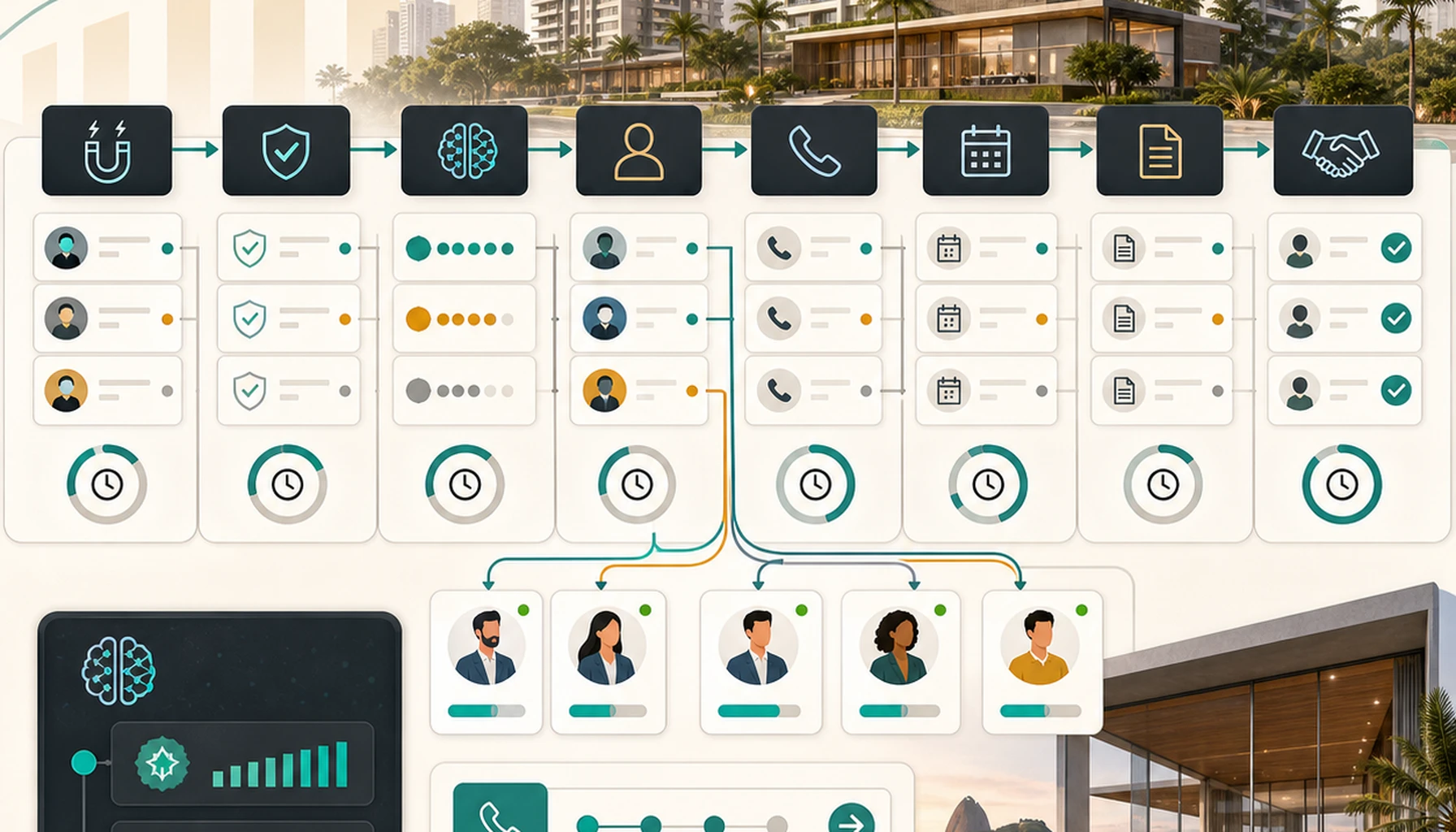
Use explicit stages:
- Capture the lead with campaign, creative, UTM, and timestamp.
- Validate contact details, consent where needed, duplicates, and geographic fit.
- Score declared and observed intent.
- Assign by availability, territory, language, or expertise.
- Record first contact and the SLA clock.
- Qualify budget, unit preference, financing readiness, and buying horizon.
- Register the visit and its outcome.
- Track proposal, reservation, contract, and loss reason.
That sequence is practical. It turns form fills into an auditable commercial process.
How should AI prioritize leads without hiding the logic?
AI should combine recent behavior with business rules, then show the broker why a contact is high, medium, or low priority. Explainable scoring earns trust because salespeople can challenge a result, correct bad data, and act with context instead of following a black-box number.
Start simple. A person who asks for a price table, returns twice within 24 hours, selects a unit type, and replies on WhatsApp has stronger near-term intent than a person who watches one generic video.
Source matters. Behavior usually matters more.
A score is not a verdict about a person. It is a work-order signal: call now, send a floor-plan comparison, or place the person in a permitted follow-up sequence.
We’ve found that historical CRM data can be patchy, especially after a new project changes the buyer profile. In that case, a predictive model may repeat old bias. Keep a human review route and test outcomes by channel, neighborhood, and broker assignment.
Why does a launch team need a first-contact SLA?
A first-contact SLA is the maximum agreed time between lead capture and a documented human response. It protects buyer attention and gives managers a measurable way to separate weak demand from a slow sales operation.
Harvard Business Review’s 2011 article The Short Life of Online Sales Leads found that companies responding within one hour were nearly seven times more likely to qualify a lead than companies responding even an hour later.[^1] The research covered online leads broadly, not Brazilian launches. The operational lesson still applies.
Set more than one clock. A high-intent lead may require a five-minute attempt during business hours; a validated medium-intent lead may have a 30-minute target; lower-intent leads can enter a consented nurture flow.
One SLA for every lead creates noise.
For every breach, show the source, assigned owner, elapsed time, and recovery action. That report often reveals a basic issue: media peaks at 8 p.m., while lead assignment only works during daytime shifts.
We test coverage before adding more automation. Fixing a roster problem is cheaper than buying another feature.

How do CRM actions connect to market intelligence?
CRM data explains what happened inside a launch funnel; market intelligence explains the conditions around it. Reading both together lets leaders distinguish an attendance problem from price positioning, competing stock, product mix, or a change in local demand.
A funnel dashboard on its own can point to the wrong culprit. If visits fall after a nearby competitor starts sales, blaming brokers without checking competing supply is weak analysis. But a strong market cannot rescue a team that takes hours to answer ready buyers.
Use a weekly decision table:
| Decision | CRM evidence | Market evidence | Owner |
|---|---|---|---|
| Shift media budget | Cost per qualified visit by campaign | Competing-launch activity | Marketing lead |
| Review unit mix | Requests and proposal preferences | Competing typologies | Product and sales |
| Revisit price narrative | Broker-recorded objections | Local price movement | Commercial director |
| Adjust staffing | SLA breaches by hour and channel | Regional launch calendar | Sales operations |
Imovitec’s Radar Imobiliário supplies the external evidence: launches, sales tables, price movement, appreciation, VGV, and sales velocity. Pair that view with VGV in real-estate launches before changing a commercial plan because of one noisy day of lead volume.
VGV (Valor Geral de Vendas) is the projected gross sales value of a development, calculated from the expected selling value of its units.
Watch the middle of the funnel, too. A launch can attract plenty of leads and still stall between visit and proposal; real-estate sales velocity gives that discussion a clearer commercial frame.
That report often reveals a basic issue: media peaks at 8 p.m., while lead assignment only works during daytime shifts.
Talk to a specialist
Want to see this applied to your case?
Instead of finishing the article and staying in theory, send us your situation on WhatsApp. We reply with the concrete next step.
Which Brazilian data rules apply to a launch CRM?
A Brazilian launch CRM must process personal data under a defined legal basis, clear notice, purpose limits, security controls, and procedures for data-subject rights. Under LGPD Article 20, people may request a review of decisions made solely through automated processing that affect their interests.[^2]
Brazil’s LGPD is Law No. 13,709/2018.[^2] Article 6 sets ten principles for personal-data processing, including purpose, adequacy, necessity, transparency, security, prevention, and accountability.[^2]
A downloaded lead list is not a permanent marketing permission. Record the source and legal basis, identify controller and processors, set retention limits, and restrict access by role.
Don’t feed every available field into a score. Sensitive personal data receives specific protection under the LGPD, and it is rarely needed to decide who should receive a floor plan first.
Document these controls before scale:
- source and legal basis for each lead;
- privacy-notice version shown or accepted;
- fields used in routing and scoring;
- automated-decision explanation and human-review path;
- retention and deletion schedule;
- CRM, WhatsApp, analytics, and media vendors;
- incident owner and response process.
The documentation can feel tedious. It prevents costly confusion later.
How can a team roll out an AI CRM in 30 days?
A 30-day rollout works when a team begins with a narrow funnel, measurable SLAs, visible scoring rules, and a controlled pilot. The aim is not to automate every conversation; it is to make the next commercial action reliable enough to improve each week.
Week 1 — Map. Name each stage, exit condition, owner, data source, and SLA. Audit duplicate records and choose the source of truth.
Week 2 — Instrument. Connect forms, campaign parameters, call logs, permitted WhatsApp events, and visit outcomes. Build a simple score with visible reasons.
Week 3 — Pilot. Route a limited share of leads to a small broker group. Compare first-contact time and visit rate against the current process, then review rejected assignments daily.
Week 4 — Check and expand. Review LGPD controls, train managers to read score reasons, publish the breach report, and expand only when the team can explain the result.
A CRM fix does not prove the offer is correctly priced. Read Imovitec’s guide to pricing real-estate launches before treating better response times as proof of product-market fit.

Put market evidence beside CRM evidence
Imovitec helps Brazilian builders, developers, agencies, and investors turn fragmented information on launches, sales tables, pricing, appreciation, VGV, and sales velocity into clearer decisions. A market briefing can show whether the bottleneck is follow-up, competing supply, unit mix, or the offer itself.
A good AI CRM does something modest but valuable: it makes the next action clearer. The right broker calls while interest is still real, and leadership can see whether the issue sits in the funnel, the product, or the market.
Talk to Imovitec and turn market data into a decision.
[^1]: Harvard Business Review, “The Short Life of Online Sales Leads” (2011): https://hbr.org/2011/03/the-short-life-of-online-sales-leads [^2]: Presidência da República, Lei nº 13.709/2018 (LGPD), especially Articles 6, 18, 20, and 46: https://www.planalto.gov.br/ccivil_03/_ato2015-2018/2018/lei/l13709.htm
FAQ
How does an AI real estate CRM prioritize leads for a property launch?
An AI real estate CRM prioritizes launch leads by combining observable signals such as price-table requests, repeat visits, preferred unit type, campaign source, and broker activity. It then routes high-intent contacts to available brokers and flags overdue follow-up, helping teams protect first-response SLAs during high-volume launch periods.
How can AI improve lead response time in real estate sales?
AI improves lead response time by automatically assigning inquiries according to availability, region, channel, and intent, while alerting managers when SLA thresholds are at risk. The result is a visible response queue that reduces manual triage and gives brokers the context needed to act promptly.
What’s the best way to use AI lead scoring for a real estate launch?
The best approach is to score leads using transparent, behavior-based criteria instead of an unexplained ranking. Combine actions such as landing-page visits, price-table downloads, unit preferences, source quality, and response history, then let sales managers validate the score against reservations, visits, and closed deals.
What features should a real estate CRM have for property launches?
A launch-focused real estate CRM should centralize campaign leads, broker assignments, response SLAs, follow-up tasks, unit preferences, and conversion reporting. It should also connect marketing source data with sales outcomes, so managers can identify whether performance issues stem from demand quality, coverage, or sales execution.
How do I track the sales funnel of a real estate launch?
Track the funnel by measuring each transition from inquiry to first response, qualification, visit, proposal, reservation, and sale. Segment results by campaign, broker, project, and unit profile. This exposes bottlenecks early and makes it easier to reallocate team capacity or media investment during the launch.
Is an AI real estate CRM worth the cost for a launch campaign?
An AI real estate CRM is worthwhile when it reduces lost leads, protects response-time commitments, and improves decisions on broker capacity and media spend. Evaluate ROI against measurable outcomes: faster first contact, higher visit rates, better conversion by channel, and less manager time spent consolidating spreadsheets.
Can an AI CRM be implemented securely without disrupting the sales team?
An AI CRM can be introduced securely through phased integration, role-based access, data-quality rules, and clear LGPD governance. Start with lead capture, routing, and SLA visibility before expanding automation. Training brokers on practical next actions helps adoption while keeping human judgment in control of customer conversations.
How can Imovitec help with an AI real estate CRM for the property-launch funnel?
Imovitec helps launch teams connect CRM operations with market intelligence, making lead priorities and sales decisions more evidence-based. Its approach can relate campaign activity, broker response, inventory signals, and local market context, so managers can act on conversion gaps without relying on isolated dashboards or intuition.
Related reading
Talk to a specialist
Have a real case to solve?
Message Imovitec on WhatsApp. We reply fast and already speak your context — no forms, no waiting.
Frequently asked questions
How does an AI real estate CRM prioritize leads for a property launch?
An AI real estate CRM prioritizes launch leads by combining observable signals such as price-table requests, repeat visits, preferred unit type, campaign source, and broker activity. It then routes high-intent contacts to available brokers and flags overdue follow-up, helping teams protect first-response SLAs during high-volume launch periods.
How can AI improve lead response time in real estate sales?
AI improves lead response time by automatically assigning inquiries according to availability, region, channel, and intent, while alerting managers when SLA thresholds are at risk. The result is a visible response queue that reduces manual triage and gives brokers the context needed to act promptly.
What’s the best way to use AI lead scoring for a real estate launch?
The best approach is to score leads using transparent, behavior-based criteria instead of an unexplained ranking. Combine actions such as landing-page visits, price-table downloads, unit preferences, source quality, and response history, then let sales managers validate the score against reservations, visits, and closed deals.
What features should a real estate CRM have for property launches?
A launch-focused real estate CRM should centralize campaign leads, broker assignments, response SLAs, follow-up tasks, unit preferences, and conversion reporting. It should also connect marketing source data with sales outcomes, so managers can identify whether performance issues stem from demand quality, coverage, or sales execution.
How do I track the sales funnel of a real estate launch?
Track the funnel by measuring each transition from inquiry to first response, qualification, visit, proposal, reservation, and sale. Segment results by campaign, broker, project, and unit profile. This exposes bottlenecks early and makes it easier to reallocate team capacity or media investment during the launch.
Is an AI real estate CRM worth the cost for a launch campaign?
An AI real estate CRM is worthwhile when it reduces lost leads, protects response-time commitments, and improves decisions on broker capacity and media spend. Evaluate ROI against measurable outcomes: faster first contact, higher visit rates, better conversion by channel, and less manager time spent consolidating spreadsheets.
Can an AI CRM be implemented securely without disrupting the sales team?
An AI CRM can be introduced securely through phased integration, role-based access, data-quality rules, and clear LGPD governance. Start with lead capture, routing, and SLA visibility before expanding automation. Training brokers on practical next actions helps adoption while keeping human judgment in control of customer conversations.
How can Imovitec help with an AI real estate CRM for the property-launch funnel?
Imovitec helps launch teams connect CRM operations with market intelligence, making lead priorities and sales decisions more evidence-based. Its approach can relate campaign activity, broker response, inventory signals, and local market context, so managers can act on conversion gaps without relying on isolated dashboards or intuition.
Imovitec
Turn data into next steps.
Take the Imovitec diagnostic and see where your best opportunities are.