AI Automation for Real-Estate Post-Sale and Handover: A Control-Tower Playbook
A sold apartment is not a completed transaction. It begins a handover chain that can stop at a missing document, financing condition, unsigned amendment…
Imovitec · July 18, 2026
A sold apartment is not a completed transaction. It begins a handover chain that can stop at a missing document, financing condition, unsigned amendment, notarial act, or property registration.
For Brazilian developers, those signals often sit in CRM, ERP, bank portals, WhatsApp, shared folders, and spreadsheets. The buyer sees one journey. The company sees five tabs and a growing queue.
AI helps when it acts as an operational control tower, not a chat widget. It connects approved signals, flags the next blocked action, assigns an owner, and sends uncertain cases to a qualified reviewer. We have seen a clear queue change the tone of a team’s day. Less chasing. Better decisions.
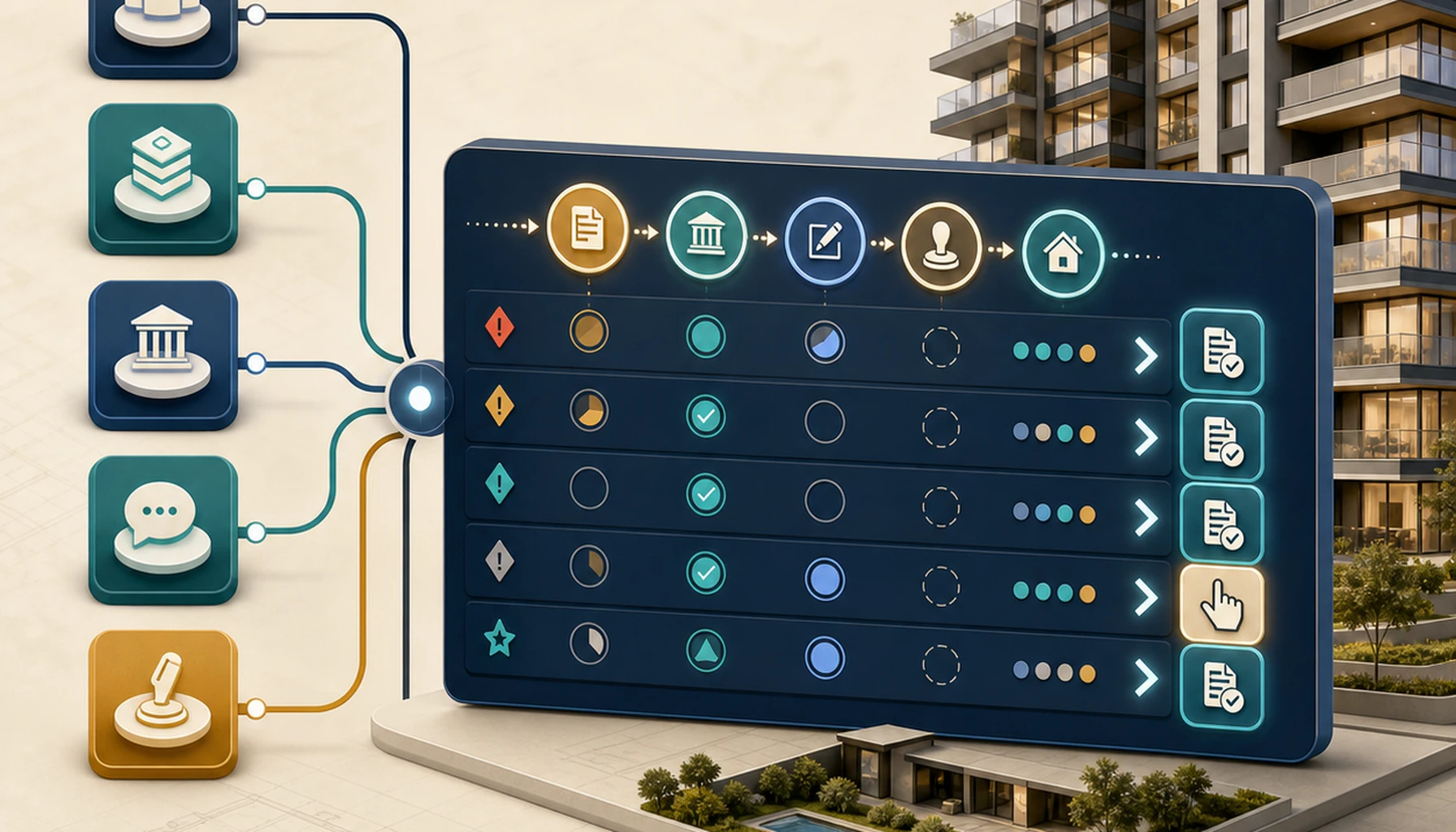
Cover-image brief: Editorial illustration of a Brazilian real-estate handover control tower: CRM, ERP, financing, signing, notary, and registry milestones feeding one governed queue, with a visible human-review checkpoint. Avoid robot imagery.
Key Takeaways
AI post-sale automation creates one accountable view of each buyer-unit case, from sale through registration. Start with document checks, aging alerts, and task routing; keep legal exceptions and low-confidence classifications with human reviewers. Brazilian implementations must respect the Lei Geral de Proteção de Dados Pessoais (LGPD) and the formal sequence of notarial and registry acts.
- A useful queue shows what is blocked, why, who owns the next action, and how long it has waited.
- The strongest first pilot covers one development and one stage, not every legacy system.
- Brazil’s LGPD is Law No. 13,709/2018; most of its provisions took effect on September 18, 2020.[1]
- Provimento CNJ No. 100/2020 established the e-Notariado framework for remote notarial acts in Brazil.[4]
- Imovitec’s Radar Imobiliário adds launch, sales-table, price, appreciation, VGV, and sales-velocity context to delivery planning.
What is AI automation for post-sale and property handover?
AI automation for real-estate post-sale and handover is a governed workflow that combines case data, finds missing or delayed requirements, recommends a next action, and records the human decision. Its purpose is simple: make the status of every buyer-unit case explicit, current, and actionable.
Post-sale automation: rules and machine-assisted classification that guide a buyer’s case through financing, contracting, signing, notarial review, and registration.
Sending a reminder is automation. Knowing that Unit 804 has waited 11 days for a bank response, has a valid CPF document but an expired income statement, and belongs with the financing desk first is operational intelligence.
A control tower normally brings together five sources: CRM, ERP, bank or correspondent updates, messaging history, and notary or registry milestones. Each buyer-unit pair receives one case ID. Different labels can then be compared without guesswork.
The legal guardrails belong in the design. Brazil’s LGPD was enacted on August 14, 2018, and regulates personal-data processing.[1] The Lei dos Registros Públicos, Law No. 6,015 of December 31, 1973, governs the public-registration framework.[2]
I’d begin with one live development and one stage. Connecting every historic database in month one usually produces a more expensive spreadsheet.
How does an AI handover control tower work?
An AI handover control tower combines fixed business rules with AI-assisted reading and classification. Rules decide what cannot move forward; AI helps interpret documents, messages, and inconsistent labels. A person decides when evidence is incomplete, confidence is low, or a legal exception appears.
The practical flow has seven steps:
- Ingest events. Import approved unit, buyer, contract, payment, financing, document, and milestone data.
- Normalize records. Match names, CPF references, unit codes, and contract identifiers to one case ID.
- Check prerequisites. Test each case against a stage checklist: valid documents, credit approval, signatures, notarial act, and registration evidence.
- Score urgency. Rank cases by delivery date, waiting time, financial exposure, dependency, and buyer impact.
- Assign a next action. Create a named task with a due date and evidence link.
- Request human review. Stop automatic progression for low-confidence or sensitive cases.
- Keep an audit trail. Record the source, rule, recommendation, owner decision, and timestamp.
The screen should answer four questions without opening six tabs: What is blocked? Why? Who acts next? How long has it waited? Many AI initiatives miss this point because they summarize activity without producing a decision.

Why automate post-sale before delivery pressure peaks?
Developers should automate post-sale before delivery pressure peaks because delays compound across dependent steps. A late financing response can hold a signature; that signature can hold notarial review; then dozens of unresolved cases arrive in the same delivery week. Early visibility turns a late surprise into a manageable task.
The cost is not merely administrative. Buyers lose confidence when updates are vague, while managers spend hours building status reports instead of removing blockers. We’ve watched strong teams become reactive because their systems could not separate a genuine exception from a routine pending item.
Registration has formal significance. Under Law No. 6,015/1973, public registration is the legal framework that gives property rights public effect against third parties in relevant transactions.[2] A dashboard cannot change that sequence. It can show the evidence, deadline, and responsible person before the queue ages.
Commercial planning belongs in the same conversation. Pair sales-velocity indicators with delivery and handover backlog to spot developments that appear healthy at launch but create operational pressure later.
The catch is data quality. If the CRM contains incomplete unit codes, or the ERP keeps a cancelled reservation as active, AI repeats that confusion faster. Fix case identity and stage definitions first.
How can a developer implement AI post-sale automation safely in Brazil?
Safe implementation starts with a narrow workflow, a named process owner, and written rules for access, escalation, evidence, and retention. The aim is dependable case handling, not automatic decisions at any cost. Expand only after the pilot produces measurable improvement and reviewers trust the queue.
Use this rollout:
- Map the real handover journey with operations, finance, legal, customer service, and correspondents.
- Define one status model: sold, documents pending, credit analysis, contracted, signed, notarial review, registered, and exception.
- Select a source of truth for identifiers and specify how conflicts are resolved.
- List required evidence for every stage, including expiry dates and validation owners.
- Start with low-risk work: reminders, status collection, duplicate detection, and backlog-aging alerts.
- Add document or message classification only with confidence thresholds, sampled quality checks, and a reviewer path.
- Review results weekly before expanding to another development or stage.
Human-in-the-loop review: a qualified person approves, corrects, or rejects an AI recommendation before a sensitive decision is finalized.
LGPD controls should be concrete: document the purpose of processing, grant access by role, minimize copied data, and record the applicable legal basis. The Autoridade Nacional de Proteção de Dados (ANPD) publishes regulatory material that legal and compliance teams should assess for the specific operation.[5] I would not allow a language model to send a legal conclusion to a buyer without an approved template and human sign-off.
Electronic signatures need context too. Law No. 14,063, dated September 23, 2020, classifies electronic-signature types for interactions with public entities and sets related rules.[3] Private property transactions may require separate contractual and evidentiary analysis. One configuration does not fit every deal.
Which metrics show that the control tower is working?
A handover control tower is working when it cuts invisible waiting and rework while making exceptions easy to explain. Track flow by stage, rather than only closed cases, because a closed service ticket can still conceal delayed registration. The 90th percentile is especially useful because averages hide the slowest cases.
Measure every week:
- Median and 90th-percentile days in each stage.
- Cases with no next action or no accountable owner.
- Backlog aging: 0–7, 8–14, 15–30, and more than 30 days.
- First-pass document acceptance rate.
- Share of recommendations sent to human review and reviewer correction rate.
- Buyer contacts per unresolved case.
- Time from financing approval to signed contract, then to notarial and registration evidence.
One slow registry-related case may be normal. Fifty cases without an owner are a management problem.
I prefer a weekly exception meeting with the live queue on screen. It reveals vague ownership quickly. Combine that discussion with real-estate appreciation analysis, and leaders can focus first on developments where delay creates greater buyer and revenue risk.
Brazil’s LGPD was enacted on August 14, 2018, and regulates personal-data processing.[1] The Lei dos Registros Públicos, Law No.
Talk to a specialist
Want to see this applied to your case?
Instead of finishing the article and staying in theory, send us your situation on WhatsApp. We reply with the concrete next step.
How can Imovitec add market context to handover decisions?
Imovitec helps Brazilian developers, agencies, and investors interpret fragmented market signals through property intelligence. Its Radar Imobiliário monitors launches, sales tables, and price movements, while its market briefings connect appreciation, VGV, and sales velocity to a local decision. That context helps leaders assess delivery pressure alongside market conditions.
A post-sale queue tells you where execution is stuck. Imovitec’s data for developers helps frame the commercial question around it: which developments face the highest pricing, inventory, or buyer-expectation risk?
If your team needs a market briefing grounded in evidence rather than instinct, talk with Imovitec. The goal is not another dashboard. It is a clearer decision about launches, inventory, pricing, and timing.
What should leaders do next?
Choose one active development, define its handover stages, and measure today’s backlog before buying another platform. Export 50 recent cases and mark every missing document, delayed response, handoff, and exception. If a coordinator cannot identify the next action in under two minutes, the control tower has a specific job to do.
Start small. Keep the human reviewer close. Then expand from evidence.
Sources and further reading
The following primary sources support the legal references in this article. Confirm transaction-specific requirements with qualified Brazilian legal and compliance professionals.
- Law No. 13,709/2018 — LGPD
- Law No. 6,015/1973 — Lei dos Registros Públicos
- Law No. 14,063/2020 — electronic signatures
- National Council of Justice — Provimento No. 100/2020
- Autoridade Nacional de Proteção de Dados — legislation and rules
FAQ
How do I automate real-estate post-sale and handover activities?
AI post-sale automation centralizes buyer, unit, document, financing, signature, notary, and registration signals in one workflow. It identifies missing prerequisites, assigns an accountable owner, and escalates exceptions for human review. Start with document checks and aging alerts, then integrate systems gradually around one prioritized handover queue.
What is included in the real-estate handover process?
A real-estate handover process covers the steps between sale and legal completion, including buyer documentation, financing conditions, contract signatures, notarial actions, property registration, and key release. A control-tower approach makes each milestone, dependency, delay, and responsible team visible before a case becomes an expensive customer-service escalation.
What's the best way to track delayed property handovers?
The best way to track delayed handovers is to manage every buyer-unit case through status, owner, next action, deadline, and blockage reason. AI can classify incoming documents, detect stalled milestones, and prioritize aging cases. Teams should retain human approval for uncertain decisions and use dashboards to resolve the highest-risk bottlenecks first.
Which documents are needed for a property handover in Brazil?
Required handover documents vary by transaction and municipality, but usually include signed contractual records, buyer identification, financing evidence when applicable, tax and registry documentation, and proof that contractual obligations were met. A governed workflow should validate completeness against the approved checklist and route exceptions to legal or operations specialists.
How can developers reduce financing and signing delays after a sale?
Developers reduce financing and signing delays by monitoring prerequisites before each deadline rather than chasing cases after they fail. Automated reminders, document-status validation, bank-pending alerts, and clear ownership expose the next blocked action. Integrating CRM, ERP, signing, and banking signals creates a more reliable post-sale operating rhythm.
Is AI post-sale automation worth the investment for a real-estate developer?
AI post-sale automation can deliver value when it targets measurable operational friction, such as document rework, overdue financing conditions, manual follow-ups, and registration backlog. Measure baseline cycle time, backlog aging, exception volume, and staff effort first. A phased rollout focused on high-volume bottlenecks makes ROI easier to validate before broader expansion.
Can AI automate handover workflows securely under Brazil's LGPD?
AI can support secure handover workflows under LGPD when data access, purpose limitation, retention, audit trails, and human oversight are designed into the process. Use approved data sources, role-based permissions, and documented review rules. Sensitive or ambiguous cases should be routed to qualified staff instead of being resolved autonomously.
How can Imovitec help with AI automation for real-estate post-sale and handover?
Imovitec can help developers design a governed post-sale control tower that connects market intelligence with operational signals across CRM, ERP, financing, signing, notary, and registry stages. The approach prioritizes usable data, accountable workflows, and measurable bottlenecks, enabling teams to improve handover visibility without treating AI as an unmanaged black box.
Related reading
Talk to a specialist
Have a real case to solve?
Message Imovitec on WhatsApp. We reply fast and already speak your context — no forms, no waiting.
Frequently asked questions
How do I automate real-estate post-sale and handover activities?
AI post-sale automation centralizes buyer, unit, document, financing, signature, notary, and registration signals in one workflow. It identifies missing prerequisites, assigns an accountable owner, and escalates exceptions for human review. Start with document checks and aging alerts, then integrate systems gradually around one prioritized handover queue.
What is included in the real-estate handover process?
A real-estate handover process covers the steps between sale and legal completion, including buyer documentation, financing conditions, contract signatures, notarial actions, property registration, and key release. A control-tower approach makes each milestone, dependency, delay, and responsible team visible before a case becomes an expensive customer-service escalation.
What's the best way to track delayed property handovers?
The best way to track delayed handovers is to manage every buyer-unit case through status, owner, next action, deadline, and blockage reason. AI can classify incoming documents, detect stalled milestones, and prioritize aging cases. Teams should retain human approval for uncertain decisions and use dashboards to resolve the highest-risk bottlenecks first.
Which documents are needed for a property handover in Brazil?
Required handover documents vary by transaction and municipality, but usually include signed contractual records, buyer identification, financing evidence when applicable, tax and registry documentation, and proof that contractual obligations were met. A governed workflow should validate completeness against the approved checklist and route exceptions to legal or operations specialists.
How can developers reduce financing and signing delays after a sale?
Developers reduce financing and signing delays by monitoring prerequisites before each deadline rather than chasing cases after they fail. Automated reminders, document-status validation, bank-pending alerts, and clear ownership expose the next blocked action. Integrating CRM, ERP, signing, and banking signals creates a more reliable post-sale operating rhythm.
Is AI post-sale automation worth the investment for a real-estate developer?
AI post-sale automation can deliver value when it targets measurable operational friction, such as document rework, overdue financing conditions, manual follow-ups, and registration backlog. Measure baseline cycle time, backlog aging, exception volume, and staff effort first. A phased rollout focused on high-volume bottlenecks makes ROI easier to validate before broader expansion.
Can AI automate handover workflows securely under Brazil's LGPD?
AI can support secure handover workflows under LGPD when data access, purpose limitation, retention, audit trails, and human oversight are designed into the process. Use approved data sources, role-based permissions, and documented review rules. Sensitive or ambiguous cases should be routed to qualified staff instead of being resolved autonomously.
How can Imovitec help with AI automation for real-estate post-sale and handover?
Imovitec can help developers design a governed post-sale control tower that connects market intelligence with operational signals across CRM, ERP, financing, signing, notary, and registry stages. The approach prioritizes usable data, accountable workflows, and measurable bottlenecks, enabling teams to improve handover visibility without treating AI as an unmanaged black box.
Imovitec
Turn data into next steps.
Take the Imovitec diagnostic and see where your best opportunities are.