How AI Cuts SDR Costs in Brazilian Property Launches Without Fewer Visits
A launch can collect hundreds of leads before the sales stand opens for a busy weekend. Collecting names is not the costly part. The costly part is assigning…
Imovitec · July 18, 2026
A launch can collect hundreds of leads before the sales stand opens for a busy weekend. Collecting names is not the costly part. The costly part is assigning skilled people to cold, duplicate, or poorly matched contacts while ready buyers wait for an answer.
AI changes the first layer of that queue. It can reply quickly, ask approved questions, identify intent, and send the right context to an SDR or broker. The point is not to remove the commercial team. It is to stop spending human time on repeatable work.
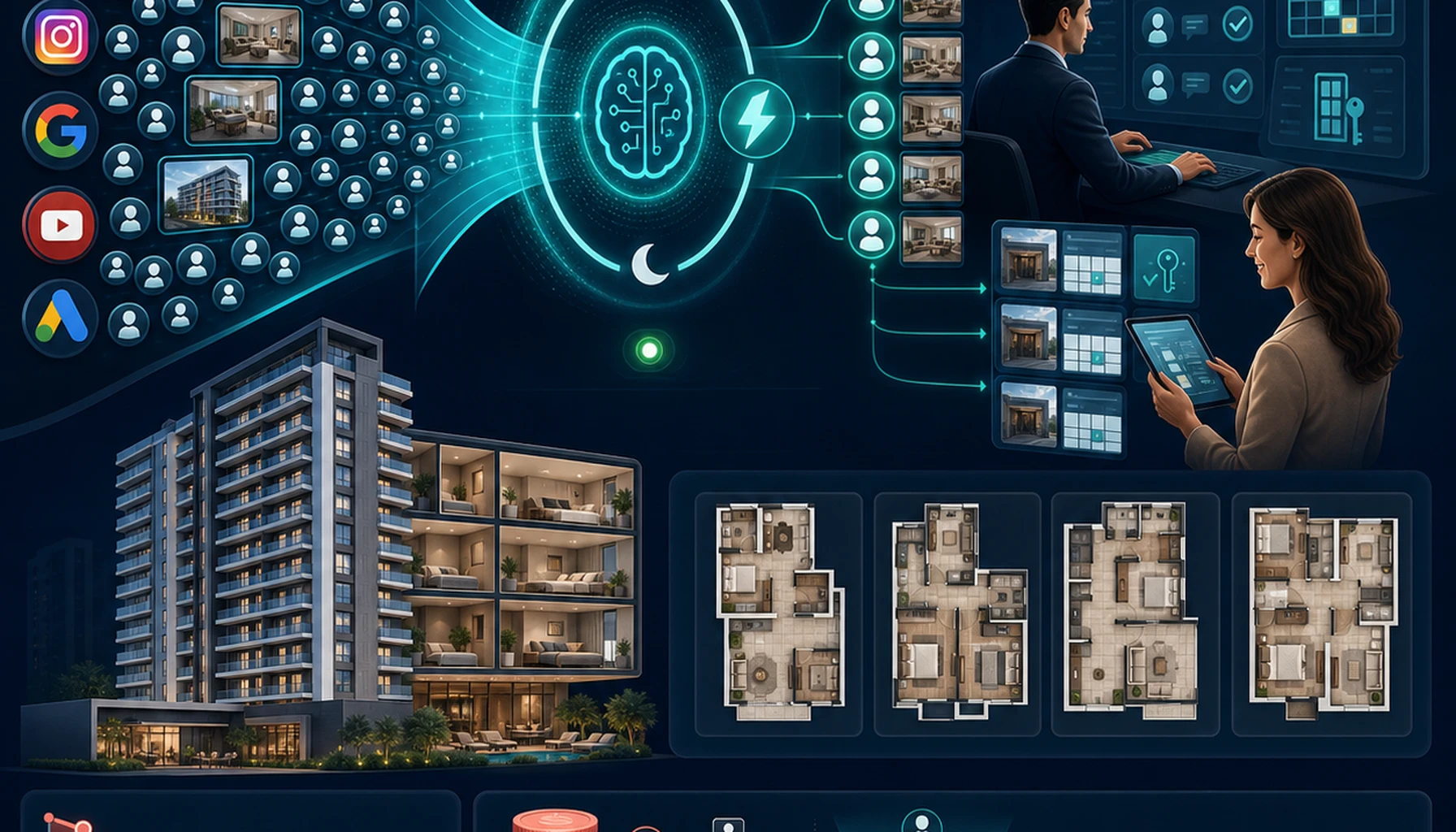
Image placement: place this editorial diagram after the introduction. Include labels for lead source, AI triage, human handoff, scheduled visit, and cost per qualified conversation.
Key Takeaways
AI can reduce SDR cost in a property launch by handling first response, basic qualification, reminders, and routing before a person joins the conversation. The gain counts only when qualified conversations, scheduled visits, completed visits, and sales velocity stay healthy.
- Harvard Business Review reported in 2011 that contacting an online lead within one hour made firms nearly seven times more likely to have a meaningful conversation than waiting longer.[^1]
- Cost per qualified conversation is more useful than cost per lead. A cheap lead that never visits is not cheap.
- McKinsey’s 2024 The State of AI survey found that 65% of respondents said their organizations regularly used generative AI in at least one business function.[^2]
- Brazil’s Lei Geral de Proteção de Dados (LGPD), Law No. 13,709/2018, governs the handling of personal data in sales operations.[^3]
- Imovitec’s Radar Imobiliário helps teams compare launches, price movements, sales tables, VGV, appreciation, and sales velocity before changing media or staffing budgets.
What does reducing SDR cost with AI mean?
Reducing SDR cost with AI means lowering the human effort required to turn raw launch leads into qualified conversations and scheduled visits, while maintaining or improving conversion quality. It is a unit-economics decision, not a chatbot race.
An SDR, or sales development representative, contacts prospects, checks fit and intent, and moves qualified buyers to the next step. In residential launches, that step is usually a visit, broker meeting, or financing simulation.
Here is the blunt version: an SDR should not spend a morning asking every Meta Lead Ads contact about unit size, preferred neighborhood, and visit availability. Those questions repeat. They also arrive at inconvenient hours.
Harvard Business Review’s The Short Life of Online Sales Leads found a sharp advantage for companies that attempted contact within one hour.[^1] That matters in launch sales because a buyer may compare several developments on the same afternoon.
In launch-team reviews, we have seen a familiar trap. Management celebrates a low cost per lead, then finds an SDR inbox full of unanswered contacts. The volume looked good; the conversations did not.
A useful AI layer works in WhatsApp, web chat, or a connected CRM. It identifies the campaign and development, records the approved notice, captures qualification signals, summarizes the exchange, and assigns a next action. It is a receptionist with rules and memory—not a magic closer.
Pair the workflow with real-estate launch indicators. Lead efficiency means little without sales, stock, price, and timing data.
How can AI lower cost without lowering conversion?
AI lowers cost by reducing first-response time and manual touches before the SDR handoff. Conversion holds when the operation uses clear qualification rules, records every outcome, and gives the human seller enough context to continue without asking the same questions again.
Coverage comes first. An assistant can acknowledge a lead at 10:47 p.m., answer a basic availability question, and offer a follow-up window for the next day. Simple, but important.
Consistency is the second gain. Each lead can receive the same core questions: unit profile, region, buying timeline, residence or investment intent, and preferred visit time. After 80 conversations, no person keeps that standard perfectly.
Priority is the third. Someone requesting a three-bedroom floor plan, mentioning pre-approved financing, and asking for a Saturday visit belongs near the top of the queue. A person seeking only a general price list can receive a lighter follow-up path.
McKinsey reported in 2024 that 65% of surveyed organizations regularly used generative AI in at least one business function.[^2] That figure does not prove revenue. It does show that AI-assisted service and sales work is now a normal operating choice for many organizations.
The catch is overqualification. Asking for income before sharing a brochure can push away a serious buyer. Early questions should earn their place by improving the recommendation, connecting the lead to a financing specialist, or securing a visit.
We recommend a human review of high-intent conversations during the first weeks of every launch. Bad scripts surface quickly there. So do product questions that the campaign failed to explain.
Why measure cost per qualified conversation?
Cost per qualified conversation connects media spend, AI cost, and SDR payroll to an interaction that meets written sales criteria. Cost per lead measures acquisition volume only; it does not show whether a person is ready for a broker follow-up.
Write the rule down. For example, a qualified conversation may require a valid contact, stated interest in the development or product category, a purchase horizon of up to 12 months, and permission for broker contact. The exact rule can differ by launch, but it cannot change every Monday.
cost per qualified conversation =
(media spend + AI platform cost + allocated SDR payroll) /
number of qualified conversations
Track cost per scheduled visit, cost per completed visit, and cost per proposal too. Those measures create a chain of evidence. A lower payroll figure is not a win if scheduled visits fall.
Here is transparent, illustrative arithmetic. A campaign spends R$60,000 on media, R$18,000 on allocated SDR payroll, and R$6,000 on its AI layer. With 280 qualified conversations under the same rule, the cost per qualified conversation is R$300.
Break the report down by source, development, and shift. Google Ads, portals, influencers, and referrals often produce different buyer behavior. A weekly launch sales-table analysis keeps that discussion tied to commercial reality.
How do you build an AI-assisted SDR workflow for a launch?
An AI-assisted SDR workflow should capture the approved notice, respond immediately, assess intent, rank the conversation, propose a next step, and send the seller a concise handoff. Start with one development and one lead source before expanding.
- Map the current funnel: source, first-response time, contact rate, qualified conversations, booked visits, completed visits, proposals, and sales.
- Write the qualification policy with sales leadership. Include disqualifiers, softer signals, escalation rules, and an owner for every handoff.
- Connect the assistant, CRM, and calendar. A spreadsheet is acceptable for a short pilot; it does not hold up at scale.
- Create short paths for unit profile, timeline, neighborhood, visit preference, price, and financing.
- Test real objections, including audio messages, competitor comparisons, deletion requests, and frustrated leads.
- Run a time-boxed or A/B pilot with comparable dates and sources. Review completed visits, not chat-completion rates alone.
- Review transcripts each week. Label poor handoffs and feed those examples into prompts, rules, and CRM fields.

Talk to a specialist
Want to see this applied to your case?
Instead of finishing the article and staying in theory, send us your situation on WhatsApp. We reply with the concrete next step.
What still needs a human SDR or broker?
Human SDRs and brokers remain responsible for nuanced financing, negotiation, emotional objections, household decisions, and closing. AI is best at speed, repetition, documentation, and routing; people are best at trust and judgment.
Do not force an assistant to answer everything. When a buyer describes a sensitive life change, disputes a price, or needs a tailored investment comparison, a human response is the right service.
We have also found that a quick escalation often beats a clever automated reply. Buyers remember being understood, especially when a purchase affects where their family will live.
Use sales velocity data and launch pricing analysis to separate an attendance problem from an offer the market is rejecting.
How should Brazilian launch teams govern AI and lead data?
Brazilian launch teams should treat AI qualification as a customer-data process: document purpose and legal basis, collect only necessary data, disclose automation clearly, control CRM access, and give people a direct route to human service or privacy requests.
Brazil’s LGPD applies to personal data used in commercial operations.[^3] Before launching a campaign, marketing, sales, legal counsel, and the data controller should agree on the privacy notice, retention period, access controls, vendor contracts, and process for data-subject requests.
Keep source records. A decision-ready report should include the period, development, lead source, qualification rule, AI cost, payroll allocation, qualified conversations, scheduled visits, completed visits, and sales.
That record protects the team from a pretty but misleading dashboard.
Before moving budget from people to software, compare the launch against its local market. Imovitec’s Radar Imobiliário turns scattered information on launches, sales tables, pricing, appreciation, VGV, and sales velocity into a market briefing for builders, developers, agencies, and investors. Visit imovitec.ai when the question is not only “Who should we contact?” but also “Is this product, price, and timing right for this market?”
The best result is not fewer SDRs on a slide. It is less repetitive work, faster care for serious buyers, and a commercial team focused where judgment changes the outcome.
[^3]: Autoridade Nacional de Proteção de Dados, “Lei Geral de Proteção de Dados Pessoais (LGPD),” Law No.
Sources
[^1]: Harvard Business Review, “The Short Life of Online Sales Leads,” 2011. [^2]: McKinsey & Company, “The State of AI in Early 2024,” 2024. [^3]: Autoridade Nacional de Proteção de Dados, “Lei Geral de Proteção de Dados Pessoais (LGPD),” Law No. 13,709/2018.
FAQ
How do I use AI to qualify real-estate leads before an SDR calls them?
AI qualifies property-launch leads by responding instantly, collecting approved buyer criteria, detecting purchase intent, and routing only relevant conversations to SDRs. This reduces manual screening while preserving human judgment for high-value prospects. Teams should define qualification rules, escalation triggers, and a clear handoff record before automating the first interaction.
Can AI reduce SDR costs without reducing scheduled property visits?
AI can reduce SDR costs without reducing visits when it removes repetitive first-contact work rather than replacing consultative selling. Fast replies, automated reminders, and intent-based routing help SDRs focus on buyers ready for a conversation. Measure qualified conversations, booked visits, attendance, and sales outcomes—not lead volume alone.
What’s the best way to automate lead follow-up for a property launch?
The best approach is to automate time-sensitive follow-up around a defined sales process. AI can acknowledge each inquiry, answer approved launch questions, capture preferred unit and budget, and trigger reminders. SDRs should take over when buyers show intent, request negotiation details, or need advice that requires human expertise.
What is lead qualification in real-estate sales?
Lead qualification is the process of assessing whether a contact matches a launch’s target buyer profile and is ready for the next sales step. Effective qualification considers intent, budget range, desired property type, location, timing, and engagement. Consistent criteria prevent SDRs from spending equal effort on every inbound lead.
How quickly should a property developer respond to a new lead?
Property developers should respond as quickly as possible, ideally while the prospect’s interest is still active. AI enables immediate first responses outside sales hours and captures context before an SDR engages. Speed matters most when combined with useful answers, accurate routing, and a timely human follow-up for qualified buyers.
How can a developer prove the ROI of AI for SDR operations?
AI ROI is proven by comparing operating cost and conversion quality before and after implementation. Track SDR hours per qualified conversation, cost per scheduled and attended visit, response time, lead-to-visit conversion, and sales progression. Start with one launch or channel, establish a baseline, and scale only after results hold.
Is it safe and difficult to deploy AI in Brazilian real-estate lead qualification?
AI deployment can be safe and manageable when it uses approved knowledge, controlled permissions, human escalation, and LGPD-aware data practices. Begin with narrow tasks such as first response and data capture, then monitor conversations and exceptions. Integrations should preserve CRM records, consent signals, and accountability for sensitive buyer information.
How can Imovitec help reduce SDR costs with AI in property-launch sales?
Imovitec can help teams connect market intelligence, launch context, and AI-assisted qualification into a measurable SDR workflow. The goal is to prioritize relevant buyer conversations, protect visit volume, and make follow-up more consistent. A practical assessment can identify where automation improves response time, routing, and commercial efficiency.
Related reading
Talk to a specialist
Have a real case to solve?
Message Imovitec on WhatsApp. We reply fast and already speak your context — no forms, no waiting.
Frequently asked questions
How do I use AI to qualify real-estate leads before an SDR calls them?
AI qualifies property-launch leads by responding instantly, collecting approved buyer criteria, detecting purchase intent, and routing only relevant conversations to SDRs. This reduces manual screening while preserving human judgment for high-value prospects. Teams should define qualification rules, escalation triggers, and a clear handoff record before automating the first interaction.
Can AI reduce SDR costs without reducing scheduled property visits?
AI can reduce SDR costs without reducing visits when it removes repetitive first-contact work rather than replacing consultative selling. Fast replies, automated reminders, and intent-based routing help SDRs focus on buyers ready for a conversation. Measure qualified conversations, booked visits, attendance, and sales outcomes—not lead volume alone.
What’s the best way to automate lead follow-up for a property launch?
The best approach is to automate time-sensitive follow-up around a defined sales process. AI can acknowledge each inquiry, answer approved launch questions, capture preferred unit and budget, and trigger reminders. SDRs should take over when buyers show intent, request negotiation details, or need advice that requires human expertise.
What is lead qualification in real-estate sales?
Lead qualification is the process of assessing whether a contact matches a launch’s target buyer profile and is ready for the next sales step. Effective qualification considers intent, budget range, desired property type, location, timing, and engagement. Consistent criteria prevent SDRs from spending equal effort on every inbound lead.
How quickly should a property developer respond to a new lead?
Property developers should respond as quickly as possible, ideally while the prospect’s interest is still active. AI enables immediate first responses outside sales hours and captures context before an SDR engages. Speed matters most when combined with useful answers, accurate routing, and a timely human follow-up for qualified buyers.
How can a developer prove the ROI of AI for SDR operations?
AI ROI is proven by comparing operating cost and conversion quality before and after implementation. Track SDR hours per qualified conversation, cost per scheduled and attended visit, response time, lead-to-visit conversion, and sales progression. Start with one launch or channel, establish a baseline, and scale only after results hold.
Is it safe and difficult to deploy AI in Brazilian real-estate lead qualification?
AI deployment can be safe and manageable when it uses approved knowledge, controlled permissions, human escalation, and LGPD-aware data practices. Begin with narrow tasks such as first response and data capture, then monitor conversations and exceptions. Integrations should preserve CRM records, consent signals, and accountability for sensitive buyer information.
How can Imovitec help reduce SDR costs with AI in property-launch sales?
Imovitec can help teams connect market intelligence, launch context, and AI-assisted qualification into a measurable SDR workflow. The goal is to prioritize relevant buyer conversations, protect visit volume, and make follow-up more consistent. A practical assessment can identify where automation improves response time, routing, and commercial efficiency.
Imovitec
Turn data into next steps.
Take the Imovitec diagnostic and see where your best opportunities are.