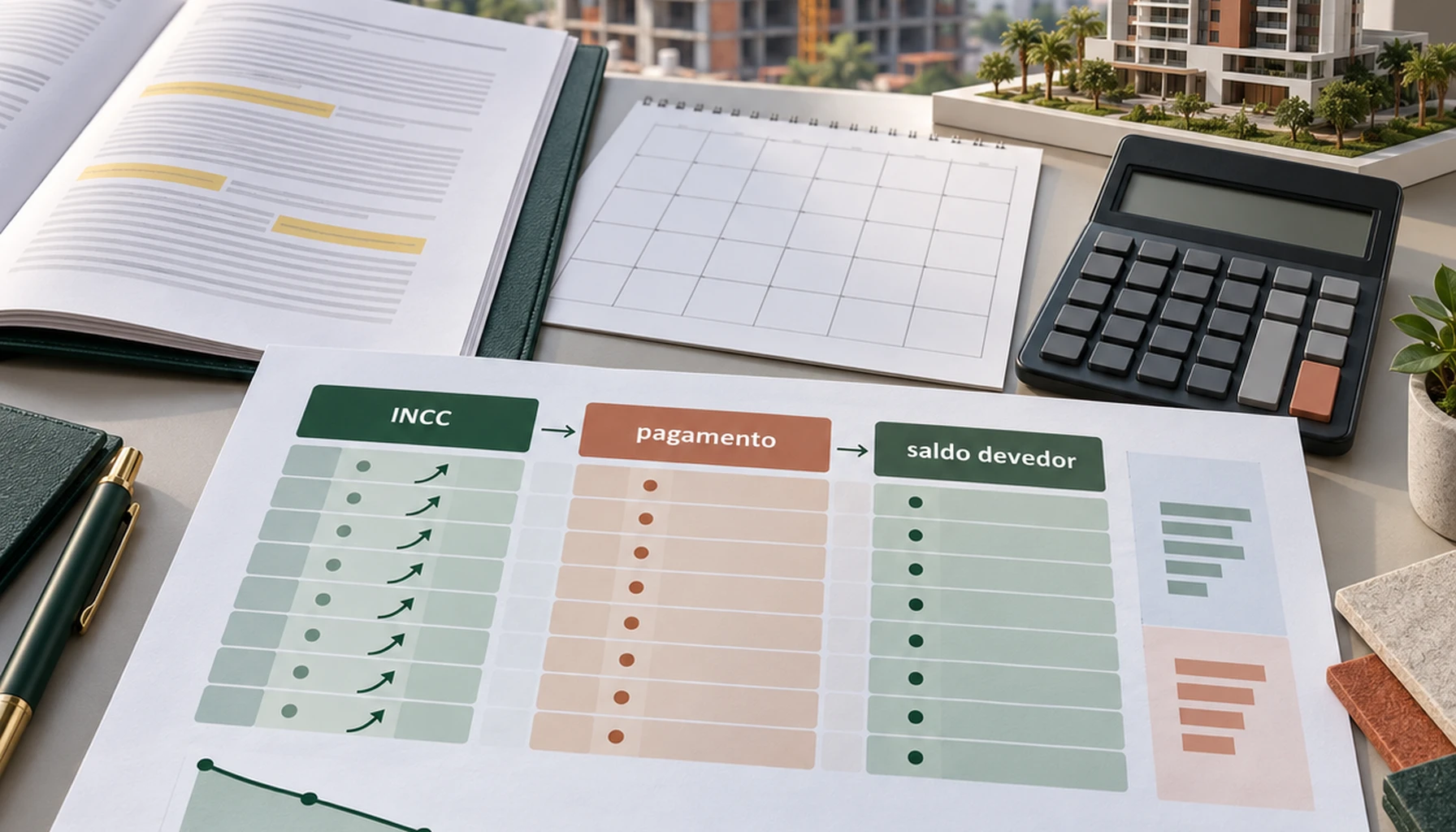
INCC on Off-Plan Property Purchases: How to Simulate Adjustments and the Outstanding Balance
Learn how to simulate INCC adjustments and an off-plan property balance without mixing index variants, interest, payments, or contract assumptions.
Imovitec · October 27, 2026
INCC adjustments can change an off-plan property's payment flow and outstanding balance in Brazil. A sound simulation begins with the contract. It must identify the index variant, base period, applicable periods, publication lag, payment schedule, and sequence of adjustment and amortization.
Even a mathematically correct spreadsheet can misstate the contractual terms. It isn't meant to promise a final amount. Instead, it should reveal assumptions, official sources, unresolved periods, calculation order, and the result's limits before a proposal is presented or a buyer's objection is answered.
Key takeaways
A reliable INCC simulation uses the exact index named in the contract, compounds official monthly factors, follows the specified sequence of adjustment and payment, and records monetary adjustment separately from interest. Periods without releases remain pending. The output is a documented estimate or reconstruction, not a replacement for the developer's statement or professional review.
- Fundação Getulio Vargas's Brazilian Institute of Economics, known as FGV IBRE, produces INCC to track selected residential construction costs.
- INCC-M, INCC-DI, and INCC-10 are not interchangeable inputs.
- Monthly percentages are compounded by multiplying their factors, not by simple addition.
- Adjusting the balance before deducting a payment produces a different result from deducting the payment first.
- Interest and monetary adjustment require separate fields.
- An unpublished rate is neither zero nor a repetition of the previous month's figure.
- No evidence reviewed supports a universal rule for INCC after completion, occupancy approval, key delivery, or developer delay.
What is INCC?
INCC, the National Construction Cost Index, is an FGV IBRE indicator that follows changes in selected materials and equipment, services, and labor costs in residential construction. Its declared geographic scope covers seven Brazilian capitals. The index measures construction costs under a defined methodology, not the market appreciation of an individual property.
Concise definition: INCC is an FGV IBRE index that tracks selected residential construction costs in Brazil.
According to FGV IBRE, the covered cities are Recife, Salvador, Rio de Janeiro, São Paulo, Belo Horizonte, Brasília, and Porto Alegre. The definition and scope appear on the institutional INCC overview and detailed INCC page, both accessed on October 27, 2026.
One limitation matters here: the retrieved material did not contain every methodological detail. Before publishing a numerical calculation or conducting an audit, the full methodology and the release for each relevant period must be checked.
FGV IBRE also announced a change to the INCC weighting structure beginning in July 2023. Its first institutional announcement and second announcement, accessed on October 27, 2026, document that change. Neither replaces the complete technical note.
Is INCC the same as property appreciation?
No. INCC tracks selected residential construction costs within its methodology and geographic coverage. Property appreciation concerns market value, which may reflect location, supply, demand, and the unit's characteristics. A contract balance adjusted by INCC does not demonstrate that an apartment appreciated by the same amount.
That distinction is also relevant when reviewing the total cost of an off-plan property in Brazil. A contractual adjustment can alter the purchase cash flow, but it does not establish a resale price.
Which INCC variant should the simulation use?
Use the variant expressly named in the contract, together with only the reference periods made applicable by that document. Retrieved FGV IBRE material confirms that INCC-M and INCC-DI use different collection windows. The complete INCC-10 window was not recovered, so it must be verified on the original FGV page before publication.
The broker should record:
- The index variant's complete name.
- The contractual base date or reference period.
- The adjustment frequency.
- Any lag between the index period and the charge.
- The amount subject to adjustment.
- Whether adjustment occurs before or after payment is deducted.
- The contractual rounding rule, if stated.
- The official URL and publication date for each rate.
These are prudent review fields, not universal legal rules. How they apply depends on the contract and governing law. The compiled Brazilian Law No. 10,931 of August 2, 2004, accessed on October 27, 2026, may be relevant, but the provision needed for this question was not fully recovered. A lawyer must assess enforceability and the legally permitted adjustment frequency.
How do you calculate an accumulated INCC adjustment?
For a closed contractual interval, convert each applicable official monthly rate into decimal form. Add one to every rate, then multiply the resulting factors. Finally, multiply the contractual base amount in reais by that accumulated factor. Every rate must come from the same variant and the periods required by the contract.
Accumulated factor equals the product of each applicable monthly factor, with each factor equal to one plus that month's decimal rate. Updated value equals the contractual base value multiplied by the accumulated factor.
Do not add monthly percentages.
Retain greater precision inside the worksheet and round currency only where the contract requires it. If the agreement provides no rounding rule, keep the internal precision and round only the displayed result.
To verify an accumulated rate, subtract one from the product of the monthly factors. Compare the answer with the official accumulated figure for the same variant and precisely the same closed interval. Minor differences may result from rounding in the published monthly rates.
What should happen when a monthly index has not been published?
Mark that period as pending and block the definitive result. Never assume zero, repeat the preceding rate, or interpolate between months. If an operational forecast is indispensable, label it as a projection and keep it separate from calculations based entirely on published FGV IBRE releases.
The December 2024 INCC-M release supports only that reference period. The May 2025 INCC-M release was the latest located in the supplied research, but it was not necessarily the latest available on October 27, 2026. No rates were recovered from either page, so no figures are inserted here.

How do you simulate the outstanding balance month by month?
Create one row for every applicable reference period. Record the opening balance in reais, the official monthly rate, adjustment amount, principal payment, any contractually applicable interest in its own field, and the closing balance. Because the contract's sequence determines which balance receives the index, there is no universal default order.
Scenario A: adjustment before amortization
When the contract calls for adjustment first, multiply the previous balance by one plus the monthly decimal rate. Then subtract the amount actually allocated to principal.
Closing balance equals previous balance multiplied by one plus the monthly rate, minus amortization.
Scenario B: amortization before adjustment
When payment reduces principal first, subtract amortization from the previous balance. Apply one plus the monthly decimal rate to the reduced amount.
Closing balance equals previous balance minus amortization, with the monthly factor then applied to that reduced amount.
The two sequences produce different totals. Use only the order supported by the contract. If a clause or statement is ambiguous, financial and legal reviewers should examine it.
When can a payment be entered as zero? Only when nonpayment for that period has been confirmed. A missing receipt, uncertain allocation, or unpublished index leaves the row unresolved. Keep the payment schedule, receipts, amendments, and statements with the calculation record.
The complete INCC-10 window was not recovered, so it must be verified on the original FGV page before publication.
How can you simulate one future installment?
Begin with the installment's contractual base amount in reais. Multiply it by the product of the monthly factors for the applicable periods between the base period and charge period, including any contractual lag. If a required rate remains unpublished, the definitive installment is pending and any forecast must be labeled as such.
Adjusted installment equals the base installment multiplied by the product of all applicable monthly factors.
This reproducible method does not prove that monthly installments, balloon payments, key-delivery amounts, and bank-financed balances always receive identical treatment. Different bases or transition rules may appear in the contract.
Before running the calculation, reconcile the proposal with the developer's documents. The same documentary discipline appears in how to read a Brazilian developer sales table.
Talk to a specialist
Want to see this applied to your case?
Instead of finishing the article and staying in theory, send us your situation on WhatsApp. We reply with the concrete next step.
What must an auditable INCC worksheet contain?
An auditable worksheet must enable another professional to locate the governing clause, reproduce every rate and payment, and trace the contractual sequence from opening to closing balance. It should retain source URLs, publication dates, units, periods, internal precision, rounding treatment, and the status of each entry as published, pending, or projected.
| Field | What to record | Control |
|---|---|---|
| Contract reference | Clause and document version | Do not rely only on a sales summary |
| Index | Exact INCC variant | Never mix variants |
| Reference period | Month used in each row | Apply contractual lag |
| Source | FGV IBRE URL and publication date | Keep one source record per rate |
| Opening balance | Amount in reais subject to adjustment | Confirm the contractual base |
| Adjustment | Rate, factor, and amount | Preserve internal precision |
| Payment | Amount and allocation | Match receipt and schedule |
| Interest | Separate amount and basis | Do not merge with adjustment |
| Closing balance | Result after the contractual sequence | Carry it forward consistently |
| Status | Published, pending, or projected | Do not present estimates as facts |
This trail becomes important if the buyer later considers an assignment, because the adjusted outstanding balance affects what the seller may retain. Even then, the retained amount depends on the relevant documents and transaction terms.
What are the most common simulation errors?
Serious mistakes usually appear when a worksheet departs from the contract or conceals uncertainty. Common failures include mixing variants, selecting the wrong reference period or base, adding rates, reversing the event sequence, merging interest with adjustment, inventing a missing rate, rounding prematurely, and presenting a projection as final.
- Selecting INCC-M when the contract names another variant.
- Ignoring the contractual lag.
- Adding monthly rates instead of multiplying factors.
- Applying the index to the wrong amount.
- Reversing adjustment and amortization.
- Combining monetary adjustment and interest.
- Treating an unpublished rate as zero or copying the previous month.
- Rounding every intermediate row without contractual support.
- Presenting a forecast as a final debt statement.
- Claiming identical treatment after completion, occupancy approval, key delivery, or construction delay.
The evidence reviewed supports no universal rule allowing INCC to be charged until key delivery in every case. Nor does it support a blanket rule requiring developer delay to trigger replacement by IPCA, IGP-M, or another index. The answer depends on the contract, case facts, current law, and applicable case law.

When is legal or financial review necessary?
Seek legal review for questions involving clause validity, consumer law, default, developer delay, completion, key delivery, construction interest, or judicial precedent. Financial review is appropriate for payment allocation, event sequence, interest, total effective cost, rounding, and transition to bank financing. Ambiguous records may require both before anyone presents a definitive figure.
A Superior Court of Justice news item dated August 10, 2020, reported a specific Third Panel decision in which an allegedly abusive monetary adjustment was not enough, by itself, to eliminate buyer default. This STJ report describes one case, not an automatic rule. The underlying judgment should be reviewed before the decision is cited more broadly.
A separate STJ document concerning Special Appeal No. 1,729,593, published September 18, 2018, concerns the contractual transfer of construction interest in financing. The recovered record does not establish the later judgment, final holding, or factual fit. Without further legal research, it cannot support advice about an individual contract.
What can a broker safely explain to a buyer?
A broker can identify the contractual index, display the official monthly factors, explain the order of adjustment and payment, separate interest, and flag missing information. The explanation should also make clear that the simulation depends on declared inputs. It does not replace the developer's formal statement, financing documents, or legal and financial review.
Traceability makes the explanation useful. Each figure should point to a clause, payment record, or dated FGV IBRE release. Every unresolved issue must remain visible.
No Imovitec CTA is included because the approved editorial brief identifies no verified offer or supported next action for this decision.
FAQ
How do I calculate INCC adjustments on an off-plan property?
Calculate the adjustment by identifying the INCC variant and applicable months in the contract, then multiplying the base amount by each official monthly factor from FGV IBRE. Do not add monthly percentages or combine INCC-M, INCC-DI, and INCC-10. Mark unpublished periods as pending rather than estimating a definitive balance.
Is INCC applied to each installment or to the outstanding balance?
INCC may affect installments, the outstanding balance, or another contractually defined amount, depending on the agreement. Verify the adjustment base, reference date, publication lag, and payment sequence in the signed contract. Do not assume that installments, key payments, and the future financed balance follow an identical calculation.
What's the best way to simulate an INCC-adjusted outstanding balance?
The best simulation uses one row per applicable month, official FGV IBRE rates, and the payment schedule. Apply either adjustment before amortization or amortization before adjustment exactly as the contract provides, because the results differ. Keep monetary adjustment, interest, payments, assumptions, and unresolved periods in separate, traceable fields.
What is the current INCC rate, and which rate should I use?
The relevant INCC rate is the official rate for the variant and reference period specified in the contract, not simply the latest percentage found online. Check the corresponding FGV IBRE release and publication lag. A current INCC-M figure cannot replace INCC-DI or INCC-10 in a contractual reconstruction.
Can an INCC calculator accurately predict the final property balance?
An INCC calculator produces a conditional estimate, not a guaranteed final balance. Accuracy depends on the correct contract terms, official monthly releases, payment dates, adjustment base, calculation order, interest, and rounding rules. Future rates remain unknown, so projections should label assumptions and distinguish them from calculations based on already published data.
Is preparing a detailed INCC simulation worth the time for a real-estate broker?
A documented simulation helps a broker detect inconsistent assumptions before presenting a proposal or answering a buyer’s objection. Its value lies in reducing decision risk, not promising savings or a final price. Compare the worksheet with the contract, payment records, and developer statement, then request financial or legal review when necessary.
Can one INCC simulation method be used for every off-plan property contract in Brazil?
No single template can determine every contract’s result without adaptation. FGV IBRE calculates INCC using construction-cost data from seven Brazilian capitals, but contractual application varies. Confirm the index variant, periods, adjustment base, payment order, and additional charges for each case. Questions involving clauses, delays, or legality require qualified review.
Talk to a specialist
Have a real case to solve?
Message Imovitec on WhatsApp. We reply fast and already speak your context — no forms, no waiting.
Frequently asked questions
How do I calculate INCC adjustments on an off-plan property?
Calculate the adjustment by identifying the INCC variant and applicable months in the contract, then multiplying the base amount by each official monthly factor from FGV IBRE. Do not add monthly percentages or combine INCC-M, INCC-DI, and INCC-10. Mark unpublished periods as pending rather than estimating a definitive balance.
Is INCC applied to each installment or to the outstanding balance?
INCC may affect installments, the outstanding balance, or another contractually defined amount, depending on the agreement. Verify the adjustment base, reference date, publication lag, and payment sequence in the signed contract. Do not assume that installments, key payments, and the future financed balance follow an identical calculation.
What's the best way to simulate an INCC-adjusted outstanding balance?
The best simulation uses one row per applicable month, official FGV IBRE rates, and the payment schedule. Apply either adjustment before amortization or amortization before adjustment exactly as the contract provides, because the results differ. Keep monetary adjustment, interest, payments, assumptions, and unresolved periods in separate, traceable fields.
What is the current INCC rate, and which rate should I use?
The relevant INCC rate is the official rate for the variant and reference period specified in the contract, not simply the latest percentage found online. Check the corresponding FGV IBRE release and publication lag. A current INCC-M figure cannot replace INCC-DI or INCC-10 in a contractual reconstruction.
Can an INCC calculator accurately predict the final property balance?
An INCC calculator produces a conditional estimate, not a guaranteed final balance. Accuracy depends on the correct contract terms, official monthly releases, payment dates, adjustment base, calculation order, interest, and rounding rules. Future rates remain unknown, so projections should label assumptions and distinguish them from calculations based on already published data.
Is preparing a detailed INCC simulation worth the time for a real-estate broker?
A documented simulation helps a broker detect inconsistent assumptions before presenting a proposal or answering a buyer’s objection. Its value lies in reducing decision risk, not promising savings or a final price. Compare the worksheet with the contract, payment records, and developer statement, then request financial or legal review when necessary.
Can one INCC simulation method be used for every off-plan property contract in Brazil?
No single template can determine every contract’s result without adaptation. FGV IBRE calculates INCC using construction-cost data from seven Brazilian capitals, but contractual application varies. Confirm the index variant, periods, adjustment base, payment order, and additional charges for each case. Questions involving clauses, delays, or legality require qualified review.
Imovitec
Turn data into next steps.
Take the Imovitec diagnostic and see where your best opportunities are.