How to Read a Brazilian Developer Sales Table Before Buying Off-Plan
How to Read a Brazilian Developer Sales Table Before Buying Off Plan A developer sales table can make a R$700,000 apartment look simple. It isn't. The document sets out the unit price, payment timing,
Imovitec · July 16, 2026
A developer sales table can make a R$700,000 apartment look simple. It isn't. The document sets out the unit price, payment timing, outstanding balance, and usually the construction-cost correction that can change what you actually pay.
I've reviewed proposals where the buyer focused on the monthly installment and missed the payment due at handover. Nothing was hidden. The numbers just weren't turned into a cash-flow decision.
Key Takeaways
A Brazilian developer sales table is useful only when you convert it into comparable figures: price per private square metre, cash needed before keys, payment due at handover, and the balance exposed to INCC. The advertised price is normally a starting point, not a promise of your final outlay.
- Compare units by private area, floor, orientation, parking, view, and payment flow together.
- Separate the developer-payment period from the later mortgage or cash-settlement period.
- Confirm the contract's correction index, base month, and affected installments.
- Request the dated table, full written proposal, delivery schedule, and contract draft before reserving.
What is a developer sales table?
A developer sales table lists available units, base prices, commercial conditions, and payment dates for a development. In Brazil, it is a sales document rather than the final purchase contract, so its figures must match the written proposal and contract you eventually sign.
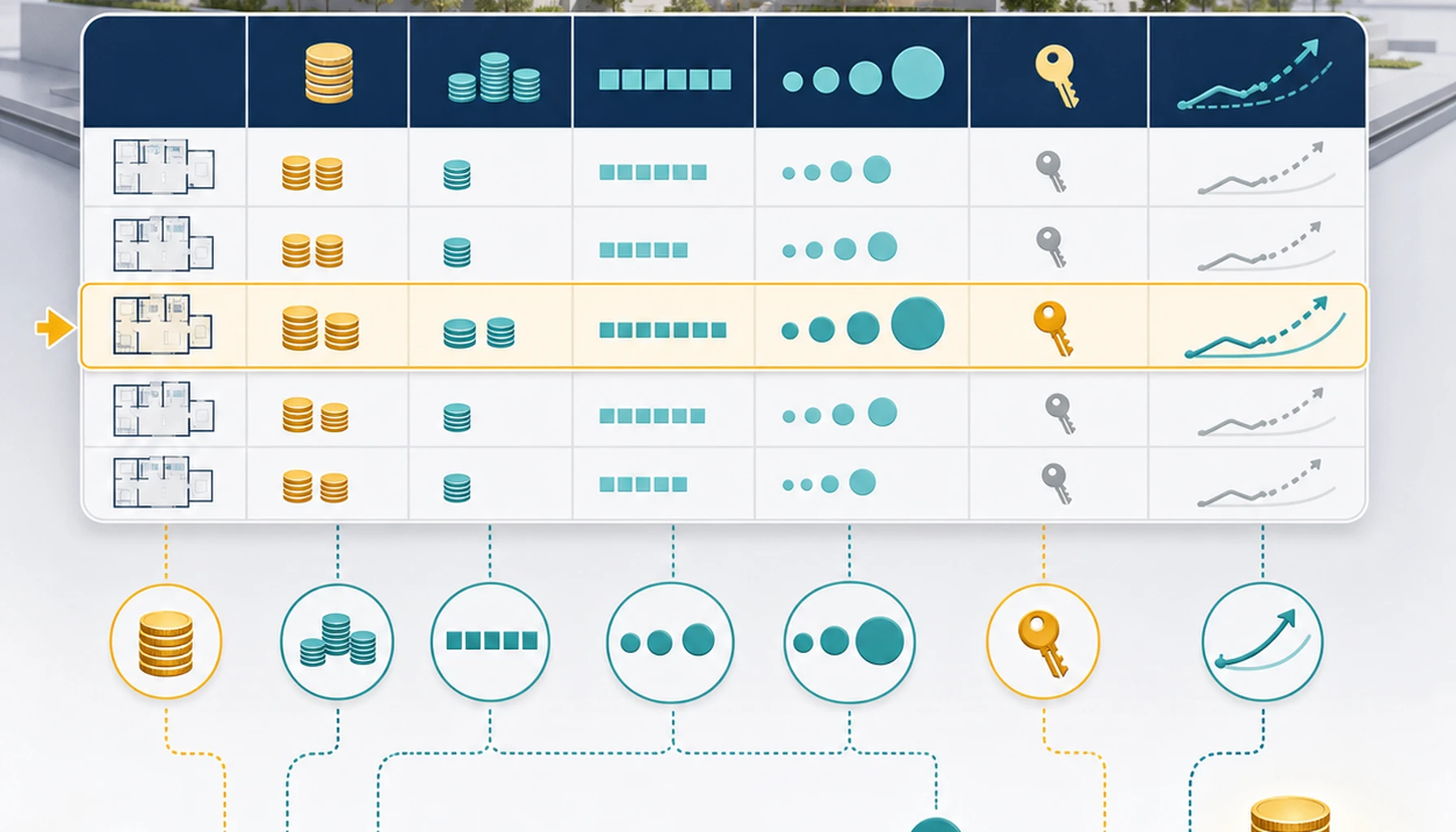
A row usually contains the tower, unit number, floor, typology, private area, parking spaces, base price, entry payment, monthly installments, annual balloon payments, handover amount, and availability status. Read every column. The small one often hurts most.
Brazil's Law No. 4,591/1964 governs condominium and incorporation rules. Law No. 10,931/2004 includes rules on the patrimônio de afetação structure used in many developments. Neither law makes a sales table a substitute for the signed contract.
How do you compare two units fairly?
Compare units by normalizing their price, physical characteristics, and payment burden. Sticker price alone is a poor comparison because a lower-priced apartment can have less private area, a weaker position, or a much larger amount due when the building is delivered.
Start here:
price per m² = base price ÷ private area
In an illustrative proposal, Unit 802 costs R$720,000 for 72 m² of private area: R$10,000 per m². Unit 1204 costs R$756,000 for 70 m²: R$10,800 per m². That is an 8% difference, calculated from the table figures, and it needs a reason—floor, view, sun exposure, an extra parking space, or a different commercial batch.
Not all square metres work the same way. A 72 m² plan with a long corridor may feel smaller than a well-planned 68 m² apartment. We always check the floor plan beside the price table, then visit the model unit if one exists.
Use this review order:
- Confirm the tower, phase, floor, orientation, private area, and unit number.
- Calculate price per m² from private area, not a vague total-area figure.
- Compare parking, storage, balcony, garden, view, and sun exposure.
- Add every payment due before keys.
- Isolate the handover payment and the balance intended for financing.
- Run at least three correction scenarios.
The guide to new property launches adds the location and competing-inventory context a sales table cannot show.
How does the payment flow change the real cost?
The payment flow determines when your money leaves, how much remains subject to construction correction, and whether bank approval will be needed later. A base price does not tell you whether the purchase fits your income, savings, or risk tolerance.
Here is an illustrative R$720,000 flow. The figures add to R$720,000 before any contractual correction: R$72,000 entry + R$72,000 in 30 monthly payments + R$60,000 in two balloon payments + R$108,000 at handover + R$408,000 remaining balance.
| Payment item | Amount | When due |
|---|---|---|
| Down payment | R$72,000 | Contract signing |
| 30 monthly installments | R$2,400 each | During construction |
| 2 balloon payments | R$30,000 each | Annual dates |
| Handover payment | R$108,000 | Delivery |
| Balance for financing or cash settlement | R$408,000 | After keys |
The catch is simple: developer approval today does not guarantee a bank mortgage three years from now. The lender can reassess income, credit, appraisal value, interest rates, and its own lending rules at the time of transfer.
I recommend asking for a written simulation that separates developer payments, correction, ITBI, deed or registry costs, condominium setup, and future financing. The financing versus buying off-plan guide explains why those phases are separate obligations.
What is INCC and why does it matter?
INCC is the National Construction Cost Index published by Fundação Getulio Vargas (FGV). In off-plan contracts, the stated INCC series commonly corrects unpaid amounts during construction, according to the contract's formula, base date, and payment schedule.
FGV publishes several series, including INCC-M and INCC-DI, on its official price-index portal. They are not interchangeable labels. Ask which series applies, which month is the reference month, when correction starts, and whether it reaches monthly, annual, and handover installments.
A R$500,000 outstanding balance exposed to an illustrative 10% cumulative correction becomes R$550,000. That R$50,000 difference is a calculation, not a forecast. The real amount depends on the monthly index results and the exact contract formula.
We've found that one request makes sales conversations much clearer: “Please show the corrected payment flow under low, middle, and high scenarios.” It forces the discussion out of headline-price mode.
Read the INCC guide for property buyers before assuming the index applies in the same way to every payment.

Which columns deserve the closest attention?
The most important columns are private area, base price, entry payment, monthly installments, balloon payments, handover balance, correction index, status, table date, and offer validity. Together, they reveal the value of the unit and the buyer's short-term cash requirement.
“Chaves,” “entrega,” “repasse,” and “parcela única” usually point to a payment near delivery. It may be large. A future date makes it easy to ignore, which is why this column deserves a bright mark on your own worksheet.
Status matters too. “Available,” “reserved,” “sold,” and “under proposal” are different commercial states. A reservation may expire, and a developer can issue a new price table. Ask for the version date and validity period in writing.
A higher table price does not prove market appreciation. It can reflect a new sales batch or a pricing decision. Use the property appreciation assessment guide to distinguish asking-price movement from local market evidence.
Talk to a specialist
Want to see this applied to your case?
Instead of finishing the article and staying in theory, send us your situation on WhatsApp. We reply with the concrete next step.
What should you ask before signing?
Before signing, ask for the documents and answers needed to reconstruct the full obligation from contract date to handover. A consultant's explanation helps, but the written proposal and contract govern the transaction.
Ask these questions directly:
- What is the total nominal price, and what is the base month?
- Which index corrects unpaid amounts, and from which date?
- Are monthly, annual, and handover payments all corrected?
- What must I pay at keys if mortgage financing is denied?
- What is the delivery date and contractual tolerance period?
- Which costs sit outside the table: ITBI, deed, registry, condominium, or bank fees?
- What happens in a transfer, cancellation, or late-payment situation?
Brazil's Consumer Protection Code, including Article 52 on consumer-credit information, supports clear disclosure of cost conditions. I'd have a real-estate lawyer or trusted specialist review the contract. For a commitment measured in years, that cost is usually money well spent.

Check local evidence before choosing a unit
A sales table tells you what the developer is asking. It does not show whether that price, payment structure, or launch timing makes sense against competing supply, sales velocity, and local price movement.
Imovitec's Radar Imobiliário tracks launches, sales tables, price movements, VGV, and sales velocity in the Brazilian market. If you want a market briefing before making an offer, talk to Imovitec. The aim is a clearer decision backed by local evidence, not pressure from the sales stand.
Turn the table into a decision tool
A developer sales table becomes a decision tool when you turn each line into four numbers: price per m², pre-key cash, corrected-balance scenarios, and financing exposure. Those figures show whether the unit fits both your budget and your reason for buying.
I wouldn't choose an apartment from a table alone. But I also wouldn't buy one without understanding the table first.
Sources and calculation notes
- Fundação Getulio Vargas, INCC price-index series.
- Brazil, Law No. 4,591/1964.
- Brazil, Law No. 10,931/2004.
- Brazil, Consumer Protection Code, Law No. 8,078/1990.
- All R$ amounts and percentage examples in this article are illustrative calculations, not market statistics or price forecasts.
FAQ
How do I read a developer sales table before buying off-plan?
A developer sales table should be read as a full cash-flow schedule, not just a property price. Check the unit’s private area, down payment, monthly and semiannual installments, handover payment, remaining balance, and adjustment index. Compare every due date with your available cash and the financing amount you can realistically obtain after completion.
What does INCC mean in an off-plan property purchase?
INCC is a Brazilian construction-cost index that commonly adjusts the outstanding developer balance while the project is being built. It can increase installments and the balance due at handover. Confirm which amounts are indexed, the calculation date, the replacement index after delivery, and whether the quoted price already reflects any adjustment.
What’s the best way to compare two developer sales tables?
The best comparison converts both tables into the same decision metrics: price per private square metre, cash required before keys, handover exposure, indexed balance, and total payment timeline. Match comparable units by floor, orientation, parking, view, and area. A lower monthly installment may conceal a much larger balloon payment later.
What is the difference between the developer balance and mortgage financing?
The developer balance covers payments due during construction and often includes a substantial amount at handover. Mortgage financing usually begins after delivery, subject to bank approval, appraisal, income analysis, and final credit conditions. Treat financing as a separate future transaction, rather than assuming the developer’s table guarantees bank funding.
Can I negotiate the payment terms in a developer sales table?
Payment terms can often be negotiated, especially the allocation between the down payment, installments, semiannual payments, and handover amount. Ask for the revised schedule in writing and recalculate the indexed balance. A concession that lowers early installments may increase your exposure at delivery, so assess the entire payment flow.
Is buying off-plan worth it after INCC adjustments and financing costs?
Buying off-plan is worthwhile only when the total projected cost fits your cash flow and investment objective. Estimate INCC on the indexed balance, financing costs after delivery, taxes, fees, and contingency reserves. Compare that scenario with ready-property alternatives using equivalent location, unit quality, liquidity, and expected rental or resale potential.
How can I verify that a developer sales table is reliable?
A reliable sales table must align with the proposed unit, memorial de incorporação, contract, and written payment conditions. Verify the unit code, private area, parking, due dates, adjustment clause, handover balance, and penalties. Have a qualified legal and financial review resolve discrepancies before signing or paying a reservation fee.
How can Imovitec help me read a Brazilian developer sales table?
Imovitec helps buyers and real-estate teams turn sales tables into comparable market decisions. Its market intelligence can support unit benchmarking, price-per-square-metre analysis, launch monitoring, and payment-structure assessment. This makes it easier to identify whether a proposal fits local market conditions and your financial assumptions before committing.
Related reading
Talk to a specialist
Have a real case to solve?
Message Imovitec on WhatsApp. We reply fast and already speak your context — no forms, no waiting.
Frequently asked questions
How do I read a developer sales table before buying off-plan?
A developer sales table should be read as a full cash-flow schedule, not just a property price. Check the unit’s private area, down payment, monthly and semiannual installments, handover payment, remaining balance, and adjustment index. Compare every due date with your available cash and the financing amount you can realistically obtain after completion.
What does INCC mean in an off-plan property purchase?
INCC is a Brazilian construction-cost index that commonly adjusts the outstanding developer balance while the project is being built. It can increase installments and the balance due at handover. Confirm which amounts are indexed, the calculation date, the replacement index after delivery, and whether the quoted price already reflects any adjustment.
What’s the best way to compare two developer sales tables?
The best comparison converts both tables into the same decision metrics: price per private square metre, cash required before keys, handover exposure, indexed balance, and total payment timeline. Match comparable units by floor, orientation, parking, view, and area. A lower monthly installment may conceal a much larger balloon payment later.
What is the difference between the developer balance and mortgage financing?
The developer balance covers payments due during construction and often includes a substantial amount at handover. Mortgage financing usually begins after delivery, subject to bank approval, appraisal, income analysis, and final credit conditions. Treat financing as a separate future transaction, rather than assuming the developer’s table guarantees bank funding.
Can I negotiate the payment terms in a developer sales table?
Payment terms can often be negotiated, especially the allocation between the down payment, installments, semiannual payments, and handover amount. Ask for the revised schedule in writing and recalculate the indexed balance. A concession that lowers early installments may increase your exposure at delivery, so assess the entire payment flow.
Is buying off-plan worth it after INCC adjustments and financing costs?
Buying off-plan is worthwhile only when the total projected cost fits your cash flow and investment objective. Estimate INCC on the indexed balance, financing costs after delivery, taxes, fees, and contingency reserves. Compare that scenario with ready-property alternatives using equivalent location, unit quality, liquidity, and expected rental or resale potential.
How can I verify that a developer sales table is reliable?
A reliable sales table must align with the proposed unit, memorial de incorporação, contract, and written payment conditions. Verify the unit code, private area, parking, due dates, adjustment clause, handover balance, and penalties. Have a qualified legal and financial review resolve discrepancies before signing or paying a reservation fee.
How can Imovitec help me read a Brazilian developer sales table?
Imovitec helps buyers and real-estate teams turn sales tables into comparable market decisions. Its market intelligence can support unit benchmarking, price-per-square-metre analysis, launch monitoring, and payment-structure assessment. This makes it easier to identify whether a proposal fits local market conditions and your financial assumptions before committing.
Imovitec
Turn data into next steps.
Take the Imovitec diagnostic and see where your best opportunities are.