Assign or Cancel an Off-Plan Property Contract in Brazil? A R$100,000 Simulation
R$100,000 paid into an off-plan apartment can produce radically different exits. You can assign your contractual position to another buyer—a repasse—or…
Imovitec · July 18, 2026
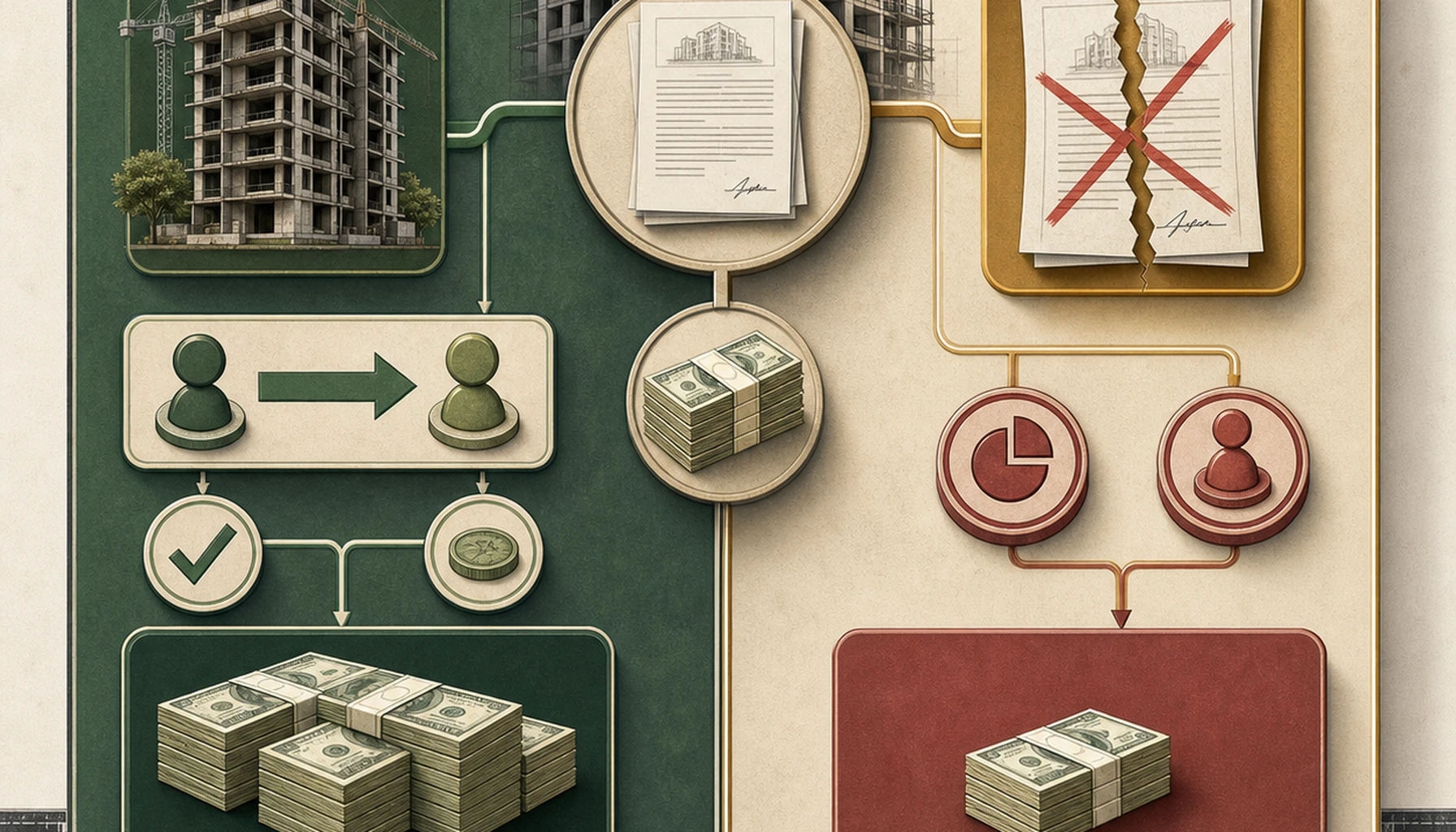
R$100,000 paid into an off-plan apartment can produce radically different exits. You can assign your contractual position to another buyer—a repasse—or terminate the agreement through a distrato. One path may return cash sooner. The other is governed by statutory refund rules and can leave a sizeable portion behind.
This is a decision model, not legal advice. The signed contract, the developer’s approval process, the project’s legal regime, and any payment default all affect the outcome. I recommend doing the math before sending a cancellation request; urgency has a habit of hiding a five-figure cost.
Key Takeaways
A repasse is usually financially stronger when a qualified buyer exists and the developer approves the transfer. A distrato is the formal fallback when transfer is impractical. In the R$100,000 illustration below, the estimated difference is R$37,000 before taxes and the time value of money.
- Repasse: transfer of the buyer’s contractual position to a new purchaser, normally subject to developer approval.
- Distrato: termination of the purchase agreement, followed by a refund after applicable deductions.
- Under Brazil’s Law No. 13,786/2018, retention may reach 25% in one statutory scenario and 50% in an affected-estate scenario, subject to the law and contract terms.[^1]
- Our illustrative repasse returns R$112,000 net; the 25% distrato illustration returns R$75,000.
- Live local inventory matters more than a broad headline index when setting a repasse price.
What is the difference between repasse and distrato?
A repasse transfers an off-plan buyer’s rights and remaining obligations to a new purchaser. A distrato ends the original contract and starts a refund calculation. The better option depends on documented net cash, payment timing, developer rules, and whether the market will actually absorb the unit.
Repasse definition: assignment of the original buyer’s contractual position to a new buyer who assumes the approved remaining obligations.
Distrato definition: termination of a property purchase commitment, with repayment of the amount due after permitted deductions.
The labels are simple. The cash flow isn’t.
In a repasse, the incoming buyer may reimburse the amounts already paid and pay a premium if the contract is attractive versus current inventory. In a distrato, the developer applies the contractual and legal framework, then pays the balance on the applicable timetable.
In contract reviews, we repeatedly see people compare a proposed sale price with a refund amount. That misses fees, dates, credit approval, and the risk that the replacement buyer disappears halfway through the process.
What does Brazil’s Distrato Law say?
Law No. 13,786/2018 amended Law No. 4,591/1964 and created important rules for buyer-initiated termination of real-estate development contracts. Article 67-A sets retention and repayment rules that differ according to the project’s legal structure. The official statutory text is the starting point for every calculation.[^1]
For developments without patrimônio de afetação, Article 67-A permits retention of up to 25% of amounts paid in the applicable buyer-default scenario, alongside items allowed by law and contract. For projects under patrimônio de afetação, the statutory ceiling can reach 50% of amounts paid.[^1]
That is not a technical detail. On R$100,000 paid, the gap between a 25% and 50% retention scenario is R$25,000.
A deduction is not automatically valid because it appears in a spreadsheet. Ask for a written calculation, payment records, and the legal basis for each item. A Brazilian real-estate lawyer should review the agreement before you sign a settlement.
How does the R$100,000 simulation work?
This simulation compares a buyer-initiated distrato with a repasse after R$100,000 has been paid on an apartment originally contracted for R$500,000. The figures are transparent assumptions, not a forecast. Your agreement and the project’s status control the real result.
Assume construction is underway and comparable units have active demand. The new buyer agrees to pay R$120,000 for the contractual position: R$100,000 to reimburse prior payments plus a R$20,000 premium.
Item Repasse Distrato Amount already paid R$100,000 R$100,000 Amount received from new buyer / refund base R$120,000 R$100,000 Transfer, documents, and negotiation costs -R$8,000 — Retention, 25% illustration — -R$25,000 Estimated net cash R$112,000 R$75,000 Practical timing 30–90 days* statutory regime and contract dependent
*The 30–90-day repasse range is an operational assumption for this example, not a legal deadline.
The repasse result is R$120,000 minus R$8,000 in assumed transfer, certificate, document, and negotiation costs. That leaves R$112,000, or R$12,000 above the cash already paid, before any tax analysis.
The distrato result is R$100,000 less a 25% retention, leaving R$75,000. If the 50% affected-estate ceiling applies, the same illustration falls to R$50,000 before other permitted deductions.[^1]
Here’s the comparison that matters: net cash, expected receipt date, and execution risk.
When does a repasse make more sense?
A repasse makes sense when the developer permits assignment, a real buyer can be approved, and the expected net proceeds exceed the likely distrato refund. It is strongest when the contract’s price or payment terms compare well with current alternatives in the same micro-market.
Start with evidence, not optimism. Compare the developer’s current table, nearby launches, available floor plans, unit position, parking, delivery date, payment conditions, and the corrected remaining balance.
A R$20,000 premium means nothing if the buyer can purchase a comparable new unit with a better installment plan.
I would check the assignment fee, credit analysis, overdue installments, and whether formal novation is required. Some developers have a clear process. Others have documentation that is genuinely frustrating, and that delay has a financial cost.
Three limits show up often:
- The developer may need to approve the incoming buyer.
- The new buyer must accept the remaining balance, INCC adjustment, and delivery risk.
- The original buyer may remain liable until the transfer is formally documented.
Brazil’s National Construction Cost Index, the INCC, commonly adjusts construction-period payments in off-plan agreements. Read how INCC and CUB affect property costs before presenting a price. An unexplained corrected balance can end a negotiation fast.

Why can a distrato take longer than expected?
A distrato can take months because the repayment date depends on the project’s legal regime and milestones, not just the day the cancellation is signed. Article 67-A provides different timelines for affected and non-affected developments, with statutory exceptions that must be checked against the specific case.[^1]
For the relevant non-affected-estate scenario, the remaining amount is payable in a single installment within 180 calendar days after termination. In the affected-estate scenario, the general rule is payment within 30 calendar days after the habite-se is issued.[^1]
Thirty days sounds quick. It is not quick if the building’s occupancy certificate is still 20 months away.
Ask the developer to confirm, in writing, whether patrimônio de afetação applies and the expected habite-se date. Distrato can still be the cleaner exit when no buyer exists, arrears cannot be cured, or assignment is blocked. Convenience, though, can be expensive.
Which market data should you check before selling the contract?
Check current launch prices, active stock, discounts, sales velocity, comparable asking prices, and neighborhood appreciation before advertising a repasse. These facts show whether the contract offers a genuine advantage to the incoming buyer and help turn an asking price into a defensible proposal.
The FipeZap Residential Sale Index tracks advertised residential sale-price movements in Brazilian cities. Its methodology is useful for city-level direction, but it does not value a particular apartment or capture every live developer concession.[^2]
That distinction matters. A compact unit near transit may behave very differently from the city average.
When we price an exit scenario, we don’t rely on a national headline alone. We examine local supply, competing payment plans, and the buyer profile most likely to take over the contract. Start with how to assess an off-plan property, then use this practical guide to property appreciation to test your assumptions.
Talk to a specialist
Want to see this applied to your case?
Instead of finishing the article and staying in theory, send us your situation on WhatsApp. We reply with the concrete next step.
How should you decide between repasse and distrato?
Choose by comparing written net proceeds, realistic payment dates, and the chance that each route closes. A seven-step review keeps an emotional exit from becoming an avoidable loss. Do the work before you accept a refund proposal or announce a price.
- Read the assignment and termination clauses. Note approval, transfer fee, brokerage, correction, default, and retention terms.
- Confirm the project regime. Request evidence of whether patrimônio de afetação applies.
- Reconcile every payment. Separate down payment, installments, brokerage, charges, and index adjustments.
- Request a written distrato statement. It should identify each deduction, its legal basis, and the expected payment date.
- Price the repasse against live inventory. Don’t use a two-year-old launch brochure.
- Run low, base, and high scenarios. Include fees, taxes, delay, and a failed-sale case.
- Formalize the winner. Do not hand over rights, possession, or keys before developer-approved documentation is complete.
R$75,000 received much later is not equal to R$75,000 today. But R$112,000 in a proposed repasse is not cash either until the buyer signs, pays, and receives approval.
In the R$100,000 illustration below, the estimated difference is R$37,000 before taxes and the time value of money.
How can Imovitec help validate a repasse price?
Imovitec’s Radar Imobiliário helps market participants compare launches, sales tables, pricing, appreciation, VGV, and sales velocity in the Brazilian market. That evidence is useful before setting a repasse price because it shows whether the contract is truly competitive against current alternatives, rather than merely sounding attractive.
For developers, agencies, investors, and buyers, a market briefing can turn a vague premium request into a price backed by current local supply and movement. If the numbers show the contract is weak, that is useful too; it may prevent weeks spent chasing an impossible sale.
Visit imovitec.ai to follow the Radar Imobiliário or request a market diagnosis before choosing your exit route.
What is the bottom line?
Repasse is generally the better financial route when the contractual position has market value, the developer approves the buyer, and the sale can close. Distrato is the formal exit when transfer is unavailable. The contract, Law No. 13,786/2018, and local demand decide the actual result.
Our R$100,000 illustration produced R$112,000 net through repasse and R$75,000 through a 25% retention distrato. Those are scenario outputs, not promises. Review the agreement with a qualified lawyer, then test the sale price against current market evidence.
[^1]: Brazil, Law No. 13,786/2018, including Article 67-A of Law No. 4,591/1964. [^2]: FipeZap Residential Sale Index and methodology.
FAQ
How do I cancel an off-plan property contract in Brazil?
Cancelling an off-plan contract is done through a formal distrato request to the developer, not simply by stopping payments. The refund, deductions, and payment timeline depend on the signed contract, buyer default, and whether the project uses patrimônio de afetação. Review these documents before agreeing to a settlement.
What percentage can a developer retain in a Brazilian property distrato?
A developer may retain a contractually and legally permitted portion of amounts paid after a distrato, with rules that vary by the project’s legal structure. For projects under patrimônio de afetação, retention can be higher. Brokerage, taxes, overdue charges, and use of the property can also affect the final refund.
What’s the best way to sell my off-plan property contract instead of cancelling it?
A repasse can preserve more value when a qualified replacement buyer pays for your contractual position and the developer approves the transfer. Compare the buyer’s offer, transfer fees, remaining installments, and likely distrato refund. A realistic R$100,000 simulation makes the cash difference and timing visible before you commit.
Does the Lei do Distrato apply to every off-plan property purchase?
The Lei do Distrato provides an important framework for many Brazilian off-plan purchase cancellations, but the result is never identical for every buyer. Contract date, payment status, project regime, construction stage, and negotiated clauses matter. Legal review is advisable when the proposed deduction or refund schedule is unclear.
When will I receive my money after cancelling an off-plan property contract?
Refund timing after a distrato is determined by the applicable legal regime and contract terms, and it may not be immediate. In some situations, payment is linked to the developer’s resale of the unit or a statutory deadline. Obtain the proposed timeline in writing and model liquidity needs separately.
Is repasse financially better than distrato after I have paid R$100,000?
Repasse is often financially better than distrato if market demand supports a transfer price that exceeds the fees and remaining obligations. In a R$100,000 comparison, calculate net proceeds under both paths, including deductions, transfer costs, taxes, and time to cash. The higher headline value is not always the better net outcome.
Is a repasse of an off-plan property contract safe?
A repasse is safer when the developer formally approves the new buyer and every payment, liability, and release is documented. Do not rely solely on an informal agreement between buyers. Confirm contract assignment rules, outstanding balances, buyer qualification, and registration requirements so the original purchaser is not left exposed.
How can Imovitec help compare repasse versus distrato with a R$100,000 simulation?
Imovitec helps teams assess repasse versus distrato with market intelligence, project context, and transparent scenario modelling. Its analysis can compare likely transfer demand, pricing signals, contractual costs, and liquidity timing across alternatives. This gives investors, developers, and advisory teams a more defensible starting point for commercial and legal decisions.
Related reading
Talk to a specialist
Have a real case to solve?
Message Imovitec on WhatsApp. We reply fast and already speak your context — no forms, no waiting.
Frequently asked questions
How do I cancel an off-plan property contract in Brazil?
Cancelling an off-plan contract is done through a formal distrato request to the developer, not simply by stopping payments. The refund, deductions, and payment timeline depend on the signed contract, buyer default, and whether the project uses patrimônio de afetação. Review these documents before agreeing to a settlement.
What percentage can a developer retain in a Brazilian property distrato?
A developer may retain a contractually and legally permitted portion of amounts paid after a distrato, with rules that vary by the project’s legal structure. For projects under patrimônio de afetação, retention can be higher. Brokerage, taxes, overdue charges, and use of the property can also affect the final refund.
What’s the best way to sell my off-plan property contract instead of cancelling it?
A repasse can preserve more value when a qualified replacement buyer pays for your contractual position and the developer approves the transfer. Compare the buyer’s offer, transfer fees, remaining installments, and likely distrato refund. A realistic R$100,000 simulation makes the cash difference and timing visible before you commit.
Does the Lei do Distrato apply to every off-plan property purchase?
The Lei do Distrato provides an important framework for many Brazilian off-plan purchase cancellations, but the result is never identical for every buyer. Contract date, payment status, project regime, construction stage, and negotiated clauses matter. Legal review is advisable when the proposed deduction or refund schedule is unclear.
When will I receive my money after cancelling an off-plan property contract?
Refund timing after a distrato is determined by the applicable legal regime and contract terms, and it may not be immediate. In some situations, payment is linked to the developer’s resale of the unit or a statutory deadline. Obtain the proposed timeline in writing and model liquidity needs separately.
Is repasse financially better than distrato after I have paid R$100,000?
Repasse is often financially better than distrato if market demand supports a transfer price that exceeds the fees and remaining obligations. In a R$100,000 comparison, calculate net proceeds under both paths, including deductions, transfer costs, taxes, and time to cash. The higher headline value is not always the better net outcome.
Is a repasse of an off-plan property contract safe?
A repasse is safer when the developer formally approves the new buyer and every payment, liability, and release is documented. Do not rely solely on an informal agreement between buyers. Confirm contract assignment rules, outstanding balances, buyer qualification, and registration requirements so the original purchaser is not left exposed.
How can Imovitec help compare repasse versus distrato with a R$100,000 simulation?
Imovitec helps teams assess repasse versus distrato with market intelligence, project context, and transparent scenario modelling. Its analysis can compare likely transfer demand, pricing signals, contractual costs, and liquidity timing across alternatives. This gives investors, developers, and advisory teams a more defensible starting point for commercial and legal decisions.
Imovitec
Turn data into next steps.
Take the Imovitec diagnostic and see where your best opportunities are.